
Procure-to-pay AI agents are most useful where the process usually fails: at the handoffs between requisition, purchase order, goods receipt, invoice and payment. Each step tends to work well enough inside its own system, but errors travel downstream when a PO is raised against the wrong supplier record or a receipt is never posted. This article walks through each stage, explains what an agent actually does there and sets out the control it should apply before passing the work on. It also covers how to govern the chain end to end and where people should stay in charge.
1. What are procure-to-pay AI agents?
Think of procure-to-pay as five handoffs rather than five steps. A requester hands a need to procurement, procurement hands a commitment to a supplier, the receiver hands back proof of delivery, the supplier sends an invoice, and AP hands a payment instruction to treasury. Procure-to-pay AI agents are software operators assigned to those stages. Each one reads the documents in front of it, checks them against the ERP and policy, takes the actions it has rights to take, and escalates anything outside its limits with a stated reason.
The difference from traditional accounts payable automation is scope and judgement. OCR and workflow tools move documents along; they rarely question what they receive. An agent working the receipt stage can notice that a PO for consultancy services has no service confirmation three weeks after the invoice arrived, and chase the budget holder before the invoice ages. The design principle is simple: no agent trusts the stage before it blindly. Every handoff gets a check, and every check leaves a record.
2. Requisition and purchase order automation: control before commitment
The cheapest place to stop a bad payment is before the order exists. At requisition, an agent can read a free-text request, map it to a category and GL code, check remaining budget on the cost centre, and point the requester to a catalogue item or an existing framework agreement. AI purchase requisition support matters less for speed than for steering spend onto contracted suppliers and terms. Where the request needs a new supplier, the agent should stop and route it to onboarding rather than creating a vendor record itself.
Purchase order automation follows the same logic. The agent drafts the PO from the approved requisition, applies contract prices and payment terms, and checks the approval matrix. One control worth building early is detection of split orders, where a requirement is broken into several POs to stay under an approval limit. Take a contractor group with entities in Dubai and Riyadh where site managers raise POs locally: an agent comparing requisitions across both entities can spot the same supplier, item and week, and send the set to the procurement lead. Access to vendor and contract intelligence gives the PO agent agreed rates to check against.
3. Goods receipt: the handoff most teams under-control
Goods receipt is where many P2P processes quietly break. Warehouses post receipts late, partial deliveries are booked as complete, and services are often never receipted because nobody owns the step. The result shows up weeks later as an invoice that cannot match, and AP is left chasing people who have moved on. An agent assigned to this stage watches open POs against expected delivery dates, prompts the named receiver when a receipt is overdue, and flags quantities that differ from the delivery note or advance shipping notice.
For services, the job is to get confirmation that work was performed before the invoice arrives. The agent can send the budget holder a short request listing the PO lines, record the reply, and post a service entry where the ERP supports it. Goods receipt matching then has real data to work with. One caution: do not let the agent that posts receipts also approve invoices against them. That combination removes the independence the three-way match relies on, and auditors will ask about it.
4. Invoice capture, matching and tax checks
At invoice stage the agent reads the document in whatever form it arrives, PDF, email body or structured e-invoice, extracts header and line data, and validates the supplier against the vendor master, including tax registration number and bank details. It then matches against PO and receipt within defined tolerances. Clean matches post. Mismatches get a first review: is it a price change covered by the contract, a quantity still awaiting receipt, or a genuine overcharge? The AP invoice verification agent pattern routes each exception to a named person with the reason already written.
Tax adds a further check. In Saudi Arabia, ZATCA e-invoicing gives invoice data and format real compliance weight, and in the UAE the VAT treatment and supporting evidence matter for audit and for Corporate Tax readiness. An agent can confirm that required fields are present and that the tax code is consistent with the supplier and item, then escalate anything doubtful to the tax team. For high-volume teams, how agents triage three-way match exceptions deserves its own design work rather than a default tolerance.
5. Payment run approval: the last control before cash leaves
By the time an invoice reaches the payment proposal, most teams assume the hard work is done. It is not. This is the final point where an error can still be stopped cheaply. A payment agent assembles the proposal from approved, due invoices and then runs its own tests: the same invoice number under two supplier records, matching amounts and dates from related vendors, recently changed bank details, and payments to suppliers with no recent PO activity. Strong duplicate payment checks belong here, independent of anything done at invoice stage.
Payment run approval should stay with people. The agent prepares the run, explains each flag and recommends holds; a treasury or finance approver releases it in the banking platform. Bank detail changes need special handling: the agent should never accept new details from an email alone, and a person should verify the change by calling a known contact before it takes effect. Treasury gains too, because confirmed payment dates can feed the cash forecast as soon as the run is approved.
6. How do you govern an end-to-end P2P agent chain?
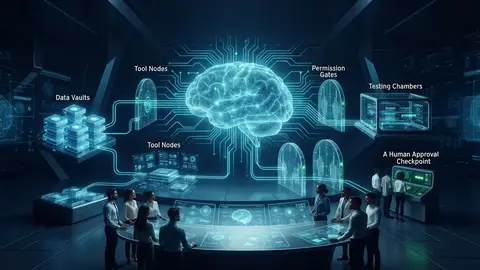
Governance is what turns a set of useful automations into P2P controls an auditor will accept. Each agent needs a written role, the actions it may take, the values above which it must escalate, and the evidence it records. Segregation of duties applies to agents as it does to people: the agent that creates a vendor should not raise POs for it, and the agent that proposes payments should not release them. Every decision, with its inputs and the policy applied, belongs in an audit trail a reviewer can follow from requisition to bank statement.
This is the model AITHENTIC uses: governed finance AI agents with defined roles, decision rights, escalation logic and a full audit trail, working inside SAP, Oracle, Microsoft Dynamics 365, NetSuite or Odoo, with people approving exceptions. In accounts payable that approach has delivered 70%+ touchless accounts payable with AED 1M+ leakage saved. Touchless accounts payable is a sensible goal for matched, low-risk invoices. It is a poor goal for new suppliers, bank changes or anything above materiality, where a human decision is the control.
Not every stage needs an agent on day one. If requisitions are mostly catalogue orders through a well-run e-procurement tool, an agent there adds little. Start where handoffs fail most often in your own data, usually receipts and invoice exceptions, and expand once internal audit has reviewed the trail. Procure-to-pay AI agents earn trust stage by stage; a chain launched all at once is hard to test and harder to explain when something goes wrong.
Key challenges
- Receipts posted late or never, especially for services, so invoices cannot match.
- Split purchase orders and off-contract spend that bypass approval limits.
- Vendor master records with outdated bank or tax details feeding every downstream stage.
- Exceptions routed without a reason, so AP chases people instead of resolving issues.
- Payment runs approved on trust, with duplicate and fraud checks applied inconsistently.
The framework
A practical operating model is 'one stage, one owner, one check'. Each P2P stage has a named agent and a named human owner. The agent performs the routine work and applies an entry check on whatever it receives: budget and contract at requisition, approval matrix at PO, quantity and timing at receipt, match and tax at invoice, duplicates and bank details at payment. Anything outside tolerance goes to the human owner with evidence and a recommended action. A governed data layer holds vendor, contract, PO and receipt data so every agent works from the same records, and one audit trail links each decision back to the originating requisition.
How to implement it
- Map your P2P handoffs and pull exception data to find where documents most often stall or fail.
- Clean and lock down the vendor master, including tax registration and bank details, before any agent depends on it.
- Write a role card for each agent covering permitted actions, escalation values and the evidence it must record.
- Start with receipt chasing and invoice exception review, with people approving every exception for the first cycles.
- Add payment-stage checks and requisition guidance once internal audit has reviewed the audit trail.
- Review tolerances, escalation volumes and override reasons monthly and adjust decision rights on evidence.
Frequently asked questions
What do procure-to-pay AI agents do?
Procure-to-pay AI agents handle the routine work at each stage of P2P, from requisition and purchase order through goods receipt, invoice and payment. Each agent checks what it receives from the previous stage against the ERP and company policy, completes the actions it is permitted to take, and escalates exceptions to a named person with the reason and supporting evidence attached.
Can AI agents approve invoices without human review?
Yes, for low-risk invoices that match the purchase order and goods receipt within agreed tolerances, provided the organisation has granted that decision right deliberately. New suppliers, bank detail changes, tax questions and amounts above a materiality threshold should always go to a person. In those cases the agent prepares the case and evidence; it does not make the call.
Which ERP systems can procure-to-pay AI agents work with?
Procure-to-pay AI agents can work inside the ERP you already run, including SAP, Oracle, Microsoft Dynamics 365, NetSuite and Odoo. They read and post through the system's interfaces and respect its approval workflows, so the ERP remains the system of record. A governed data layer such as Microsoft Fabric helps when vendor, contract and PO data sit across several systems or entities.
Where should a finance team start with AI in procure-to-pay?
Start with the handoff that fails most often in your own data, usually goods receipt or invoice exceptions. Those stages have visible queues, clear owners and measurable ageing, so improvement is easy to see. Keep people approving every exception for the first cycles, review the audit trail with internal audit, then extend agents to requisition guidance and payment checks.