
The era of the digital paper-pusher is over. While legacy automation systems struggle with complex reasoning, enterprise-grade ai agents in finance are transforming departments into governed, autonomous, and explainable powerhouses. You’ve likely encountered the friction of high model spend that lacks clear ROI or the systemic risk of black-box models in an increasingly regulated environment. We understand that in a high-stakes corporate setting, innovation without integrity is a liability.
This article demonstrates how moving beyond fragmented tools toward a governed operating model ensures your technology acts as a stabilizing force rather than an unpredictable risk. We’ll examine the shift from simple RPA to Agentic Process Automation, the impact of the EU AI Act’s 2026 transparency mandates, and the structural implementation of specialized agents across treasury, tax, and planning. Discover how to architect a finance function that is not just faster, but fundamentally smarter, more secure, and fully auditable.
Key Takeaways
- Transition from rigid, rule-based automation to goal-oriented ai agents in finance that possess the reasoning, planning, and adaptive capabilities required for complex workflows.
- Mitigate systemic risk by implementing Explainable AI (XAI) frameworks that ensure every autonomous decision remains traceable, auditable, and grounded in source data.
- Discover how specialized agents, such as Atlas for planning and Aegis for risk management, deliver function-specific intelligence that general-purpose models cannot replicate.
- Master a structured deployment roadmap that prioritizes diagnostic readiness and architectural design to ensure scalable, high-ROI AI transformation.
- Understand how the F-OS Finance Operating System serves as a foundational layer to integrate data, human oversight, and autonomous processes into a unified ecosystem.
Beyond RPA: The Evolution of AI Agents in Finance (2026)
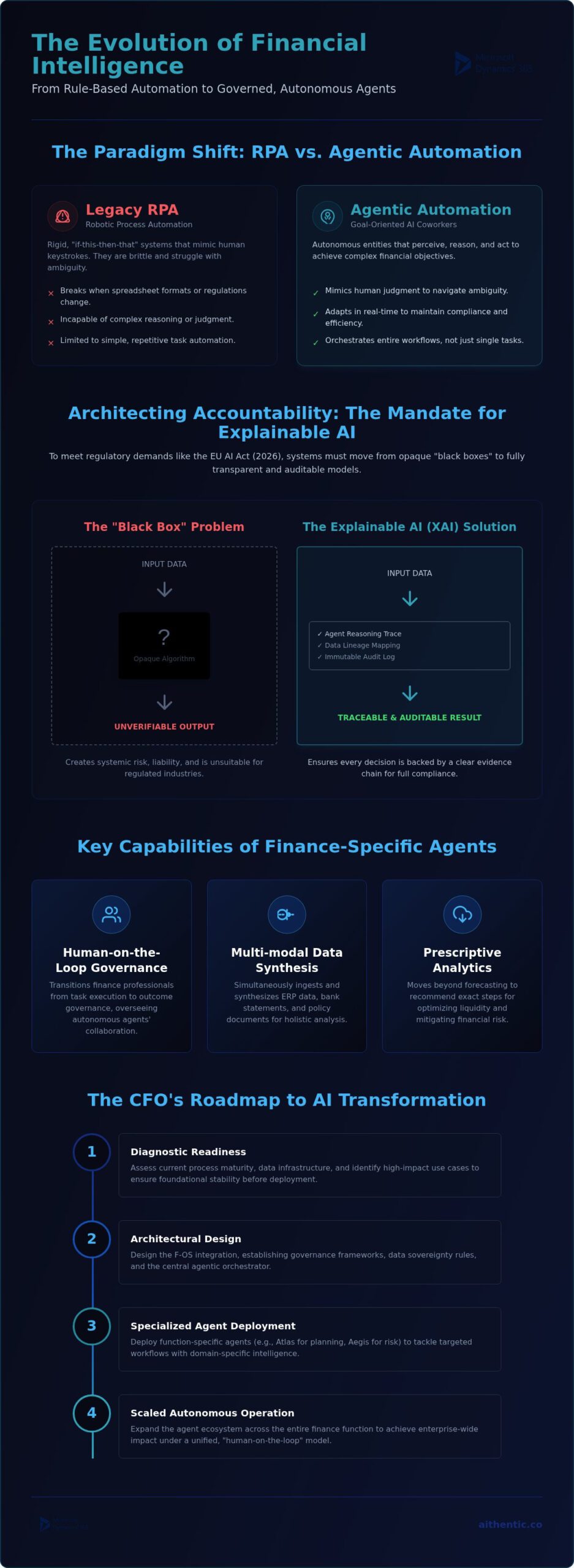
The financial sector has reached a structural inflection point. For years, Robotic Process Automation (RPA) served as the primary vehicle for efficiency, yet its limitations are now visible. RPA operates on rigid, “if-this-then-that” logic. In contrast, ai agents in finance function as goal-oriented entities capable of reasoning through ambiguity. By 2026, the global AI in finance market is projected to reach $21.2 billion, reflecting a shift from simple task automation to complex workflow orchestration. This evolution introduces the concept of an intelligent agent: a system that perceives its environment and takes actions to achieve specific objectives. While RPA mimics human keystrokes, agentic finance mimics human judgment. This distinction is critical for competitive SG&A performance. Organizations can’t rely on brittle scripts that break when a spreadsheet format changes or a regulatory requirement shifts.
The Shift from Tools to Autonomous Coworkers
Modern finance departments are moving from a human-in-the-loop model to a human-on-the-loop architecture. In this paradigm, the professional doesn’t perform the task but governs the outcome. An Agentic Orchestrator manages specialized agents, ensuring they collaborate across disparate functions. This transition marks the definitive end of the “Black Box” era. With the EU AI Act’s transparency obligations taking effect in August 2026, the demand for explainable logic has replaced the acceptance of opaque algorithms. By prioritizing clarity, integrity, and results, firms can move from experimental technology to industrial-grade application.
Key Capabilities of Finance-Specific Agents
Enterprise-grade agents possess the structural capacity for multi-modal data synthesis. They don’t just read database rows; they ingest ERP entries, bank statements, and internal policy documents simultaneously. This allows for a shift from predictive analytics, which merely suggests what might happen, to prescriptive analytics, which outlines the exact steps required to optimize liquidity or mitigate risk. By integrating ai agents in finance into the core architecture, firms gain a system that demonstrates real-time adaptability. When regulatory frameworks evolve, an agentic system doesn’t require a manual code rewrite. It updates its internal logic to maintain compliance, ensuring that operations remain secure, scalable, and strategically aligned. This isn’t just a technological upgrade; it’s a fundamental reorganization of financial intelligence.
Architecting Accountability: The Mandate for Explainable AI
For executive leadership, the primary barrier to adoption isn’t technical capability; it’s the lack of verifiable logic. In high-stakes environments like tax and audit, a hallucination is a liability that can lead to regulatory fines, reputational damage, or strategic miscalculation. The “Black Box” problem inherent in many general-purpose models makes them unsuitable for regulated industries. We define Explainable AI (XAI) as the structural ability to trace every decision made by ai agents in finance back to its specific origin in the source data. This ensures that every forecast, close, or compliance check is backed by a clear evidence chain. As noted by the OECD on AI in Finance, the move toward GenAI necessitates a focus on financial stability and the mitigation of systemic risks through rigorous transparency.
Governance Frameworks for Autonomous Systems
Accountability in an agentic ecosystem requires more than simple activity logs. It demands sophisticated audit trails that capture agent-to-agent (A2A) communications. When your planning agent queries your tax agent, the F-OS records the intent, the data exchanged, and the resulting logic. This creates a foundational layer for Model Risk Management (MRM) that is dynamic rather than static. By ensuring data sovereignty and strict privacy, we protect the integrity of global enterprise deployments. Our approach rejects the superficial “chat” interface in favor of a deeply integrated, foundational architecture that prioritizes security and functional impact. We build systems that are disciplined, reliable, and fully compliant with international standards.
Bridging the Trust Gap for CFO Approval
The “Risk Premium” associated with AI adoption often stems from a fear of the unknown. Explainability effectively removes this barrier by providing “Permission-Aware” intelligence. This means ai agents in finance operate within the same governance constraints as your human staff, respecting data silos and access controls without exception. This structural implementation fosters a culture of algorithmic accountability, where the technology serves as a stabilizing force. It moves the organization from a reactive posture to a proactive, governed operating model. If you’re seeking to implement this level of rigor, our AI transformation consulting provides the strategic roadmap necessary to transition from legacy RPA to industrial-grade autonomy. This is how we move past industry hype into measurable, predictable results.
From Atlas to Aegis: Specialized Agents in the Finance Ecosystem
The AITHENTIC F-OS architecture represents a decisive move away from fragmented toolsets toward a unified, agentic ecosystem. While generic models often struggle with the domain-specific nuances of corporate treasury or tax law, specialized ai agents in finance are engineered to address precise operational pain points. This system functions as a structural foundation where each agent possesses a distinct mandate, yet all operate under a shared governance framework. By mapping these autonomous entities to high-stakes functions, organizations can achieve a level of precision that traditional software simply cannot match. It’s not about adding more tools; it’s about deploying a coordinated workforce of intelligent agents that can analyze, predict, and optimize in real-time.
The suite’s efficacy is anchored in its functional diversity. Nexus manages liquidity through real-time cash-flow forecasting, ensuring that treasury departments maintain optimal capital positioning. Titan governs the complexities of tax and compliance, while Aegis acts as a stabilizing force for treasury risk management. These agents don’t just process data; they interpret it within the context of global market fluctuations and internal policy constraints. This integrated approach ensures that every claim of innovation is backed by a robust structural implementation, allowing executive leadership to move past experimental phases into industrial-grade application.
Strategic Planning with Atlas FP&A
Atlas transforms the strategic planning function by replacing static, manual budgeting with dynamic scenario modeling. Instead of relying on historical snapshots, Atlas integrates external market signals with internal ledger data to generate prescriptive insights. This agentic synthesis reduces planning cycles from weeks to mere hours, allowing CFOs to pivot strategies with visionary confidence. By automating the heavy lifting of data aggregation and multi-modal synthesis, Atlas ensures that FP&A accuracy is a baseline, not a goal. It’s a fundamental shift from reactive reporting to proactive, goal-oriented strategy.
Orchestrating the Close: Clarus and the Month-End Cycle
The month-end close is often characterized by manual reconciliation and high-pressure deadlines. Clarus redefines this cycle by automating anomaly detection and multi-entity consolidations across various currencies. This agent handles complex, multi-step financial logic to ensure that every ledger entry is accurate, compliant, and fully auditable. By maintaining a state of ‘Continuous Close,’ Clarus eliminates the traditional bottleneck of period-end processing. The result is a finance function that is more disciplined, transparent, and resilient, allowing human teams to focus on high-level advisory roles rather than transactional oversight.
The CFO’s Roadmap: Deploying AI Transformation at Scale
Deploying ai agents in finance is not a mere software upgrade; it is a fundamental architectural shift. For executive leadership, success depends on a methodical progression from diagnostic readiness to full-scale operational integration. This roadmap rejects the “fail fast” mentality of startups in favor of the “right first time” discipline required by global enterprise standards. By following a structured consulting framework, organizations can ensure that their transition to autonomous finance is governed, predictable, and fully aligned with strategic objectives. It is a journey from identifying systemic needs to visualizing a comprehensive, integrated solution that stabilizes the finance function.
The deployment process follows four distinct phases designed to mitigate risk while maximizing functional impact:
- Phase 1: Diagnostic and Agentic Readiness. We evaluate data quality, process maturity, and organizational alignment to ensure the foundation is secure.
- Phase 2: Architectural Design. This involves selecting the orchestration layer capable of managing complex, multi-step financial logic across disparate systems.
- Phase 3: Pilot and Governance. Specialized agents are deployed in low-risk sandboxes to verify explainability and refine agent-to-agent communications.
- Phase 4: Full-Scale Integration. The AITHENTIC F-OS is connected to the enterprise core, unifying data, people, and autonomous processes.
Synthesizing Data Strategy for AI Readiness
Agents cannot reason effectively on fragmented or corrupted information. Preparing for ai agents in finance requires cleaning legacy data for agentic consumption and establishing “Golden Records” that serve as the definitive source of financial truth. This foundational work prevents hallucinations and ensures that every agentic decision is grounded in verifiable reality. Without a disciplined data strategy, even the most sophisticated agents will fail to deliver the required operational rigor. If you’re ready to move past the experimental phase, our AI transformation consulting and advisory team can help you architect a data environment built for industrial-grade application.
Measuring ROI in Agentic Finance
Quantifying the value of an agentic operating model requires looking beyond simple productivity gains or “hours saved.” While efficiency is a baseline, the true ROI is found in enhanced strategic agility, reduced risk premiums, and improved forecast accuracy. In a market where global AI-related investment is projected to reach $1 trillion by 2026, the “Cost of Inaction” is the most significant financial risk. Firms that fail to adopt governed autonomy risk falling behind competitors who can pivot strategies in hours rather than weeks. To justify, quantify, and secure executive buy-in for this transition, finance leaders must develop a credible agentic ai business case that bridges innovation with structural governance. Measuring success means evaluating how effectively these systems mitigate volatility and support high-stakes executive decision-making.
AITHENTIC F-OS: The Future of Financial Intelligence
The AITHENTIC F-OS stands as the definitive structural foundation for the modern finance function. While generic platforms offer broad but shallow utility, this system is engineered to provide the operational rigor required by global organizations. It functions as a unified ecosystem where people, processes, and ai agents in finance operate in a state of continuous, governed synchronization. This is not a mere collection of tools but a coordinated intelligence layer that prioritizes integrity, transparency, and measurable results. By integrating these autonomous capabilities into the core architecture, we move past the era of isolated automation into a new age of systemic financial intelligence.
Bespoke Solutions for Complex Enterprises
Global business functions operate within a complex web of industry-specific regulatory requirements. AITHENTIC rejects the superficiality of off-the-shelf software, opting instead for bespoke deployment strategies that align with your unique governance needs. Our AI Transformation Consulting & Advisory services ensure that every implementation is technically sound, strategically prioritized, and fully auditable. By tailoring agents to the nuances of your specific domain, we bridge the gap between innovation and compliance. This disciplined approach ensures that your transition to the AITHENTIC F-OS: Orchestrating the Modern Finance Ecosystem is both secure and impactful, providing the stability needed for high-stakes decision-making.
Starting Your Agentic Journey
The vision for Finance 2027 is clear: a function that is predictive, autonomous, and authentic. Achieving this future requires moving beyond experimental prototypes toward industrial-grade agentic reality. The first step involves a strategic roadmap session to evaluate your current readiness and visualize a comprehensive, integrated solution. This is an invitation to partner with a Strategic Architect who understands the high stakes of global finance. We don’t just provide technology; we provide the stabilization and clarity needed to lead in a volatile market. It’s time to architect your future and move from simple automation to a governed, autonomous operating model that delivers predictable performance.
Schedule your AI Transformation Consultation with AITHENTIC to begin your journey toward a new standard of financial intelligence.
Architecting the Governed Finance Function
The transition to ai agents in finance represents a fundamental shift from superficial automation to deep operational orchestration. Organizations that prioritize explainability, integrity, and structural integration will define the next era of corporate performance. By moving beyond fragmented legacy systems toward a unified operating model, you ensure that every autonomous decision remains traceable, auditable, and strategically aligned. The AITHENTIC F-OS provides the necessary foundation to integrate complex data, govern multi-step logic, and achieve measurable results at scale. Our expertise in Explainable AI for regulated industries ensures that your transformation is both visionary and deeply disciplined.
We invite you to move past the experimental phase and begin building an industrial-grade agentic reality tailored to your specific global requirements. Whether you’re deploying specialized agents for treasury or re-architecting your entire planning ecosystem, our bespoke approach delivers the clarity and stability required for high-stakes leadership. Take the first step toward a predictive future by partnering with a Strategic Architect who understands the intricacies of your business. Design your AI Transformation Roadmap with AITHENTIC and secure your organization’s competitive resilience for 2026 and beyond.
Frequently Asked Questions
What are AI agents in finance and how do they differ from chatbots?
AI agents are autonomous entities designed to reason, plan, and execute complex workflows rather than just answering queries. Unlike consumer AI chatbots, which are limited to conversational interactions, ai agents in finance possess goal-oriented logic. They can access ERP systems, synthesize multi-modal data, and perform multi-step tasks like cash-flow forecasting or regulatory filing. This moves the technology from a simple interface to an industrial-grade operational coworker that produces measurable results.
Is agentic AI safe for highly regulated industries like banking and insurance?
Safety is ensured through rigorous governance and the implementation of “Neural-compliance” frameworks. Our F-OS Finance Operating System prioritizes ethical governance and risk mitigation by embedding regulatory requirements into the agentic core. This structural approach replaces the unpredictability of general-purpose models with a disciplined, risk-averse architecture. By utilizing specialized agents like Aegis for treasury and risk, global enterprises can maintain security while scaling autonomous operations across complex jurisdictions and high-stakes environments.
How does explainable AI prevent hallucinations in financial reporting?
Explainable AI (XAI) prevents hallucinations by enforcing a strict traceability mandate for every agentic decision. Instead of generating text from opaque statistical patterns, the system links every forecast or report back to verified source data. This creates a transparent audit trail that is essential for CFO approval. By valuing intellectual honesty over industry hype, the AITHENTIC F-OS ensures that financial reporting remains accurate, predictable, and fully defensible during internal or external audits.
Can AI agents integrate with legacy ERP systems like SAP or Oracle?
Yes, our agents are engineered for systemic integration with established enterprise cores like SAP, Oracle, and Microsoft Dynamics. The deployment process involves creating a secure orchestration layer that synthesizes data from legacy databases without disrupting existing workflows. This allows ai agents in finance to bridge the gap between fragmented historical records and modern, real-time analytics. The result is a unified ecosystem where autonomous intelligence enhances the utility and scalability of your existing technological investments.
What is the expected ROI for deploying AI agents in a finance department?
ROI is measured through a combination of productivity gains, reduced risk premiums, and enhanced strategic agility. While efficiency improvements are immediate, the long-term value lies in the “Cost of Inaction” within a volatile 2026 market. Deploying specialized agents like Atlas for FP&A reduces planning cycles from weeks to hours. This allows executive leadership to pivot strategies based on prescriptive insights, directly impacting the bottom line through optimized capital allocation and systemic rigor.
How do AI agents handle sensitive financial data and privacy compliance?
Data sovereignty and privacy are foundational to our architectural design. We implement “Permission-Aware” intelligence that respects existing enterprise security protocols and data silos. Every interaction within the AITHENTIC F-OS is governed by strict encryption and access controls, ensuring compliance with global standards like GDPR and the EU AI Act. This disciplined approach ensures that sensitive financial data is never exposed to external models, maintaining the high-stakes integrity and transparency required by corporate leadership.
What is the role of the CFO in an agent-driven finance function?
The CFO evolves from an operational overseer into a Strategic Architect of the agentic workforce. In this model, leadership shifts from managing manual tasks to governing autonomous outcomes and setting high-level strategic goals. The CFO utilizes the prescriptive analytics provided by agents to make visionary, results-oriented decisions. By moving from a human-in-the-loop to a human-on-the-loop oversight model, the CFO ensures that the technology serves as a stabilizing force for the entire organization.
How long does it take to deploy a custom AI agent for month-end close?
Deployment timelines depend on the complexity of your data environment and process maturity. Typically, a strategic roadmap session initiates the diagnostic phase, followed by the design and pilot of specialized agents like Clarus. While initial sandboxes can be operational within weeks, full-scale integration into the enterprise core is a methodical progression. This structured flow ensures that the system is industrial-grade, secure, and fully compliant before it handles live, high-stakes financial reconciliations and consolidations.