If your automation strategy still measures success by the cost-per-task, you aren’t building a future; you’re merely managing a legacy. While Gartner projects that 40% of business applications will embed autonomous AI agents by the end of 2026, many finance leaders struggle to build a credible agentic ai business case that bridges the gap between innovation and regulation. You likely feel the pressure to evolve while grappling with silos between data, people, and processes. It’s a tension between the ambition for growth and the necessity of structural governance.
This article provides the strategic framework required to architect a roadmap that satisfies both the Board and the Chief Risk Officer. We will move beyond the limitations of traditional RPA to help you justify, quantify, and secure buy-in for industrial-grade AI transformation. You’ll learn how to transition from fragmented tasks to unified, outcome-based agency. By prioritizing systemic integration, explainable logic, and operational rigor, you can transform finance from a back-office function into a proactive engine of enterprise value.
Key Takeaways
- Identify the structural shift from traditional RPA, which merely executes manual steps, to agentic AI systems designed for independent reasoning and goal-oriented execution.
- Architect a high-stakes agentic ai business case that moves beyond headcount reduction to quantify the impact of real-time liquidity orchestration and risk mitigation.
- Secure executive buy-in by mandating explainable AI frameworks that provide a transparent, auditable, and compliant decision path for every autonomous action.
- Execute a disciplined transformation roadmap that prioritizes process reengineering and strategic pilot programs to ensure long-term scalability and operational rigor.
- Discover how the AITHENTIC F-OS Finance Operating System leverages specialized agents to transform fragmented workflows into a unified, governed, and highly efficient enterprise environment.
Beyond Automation: The Strategic Shift to Agentic AI
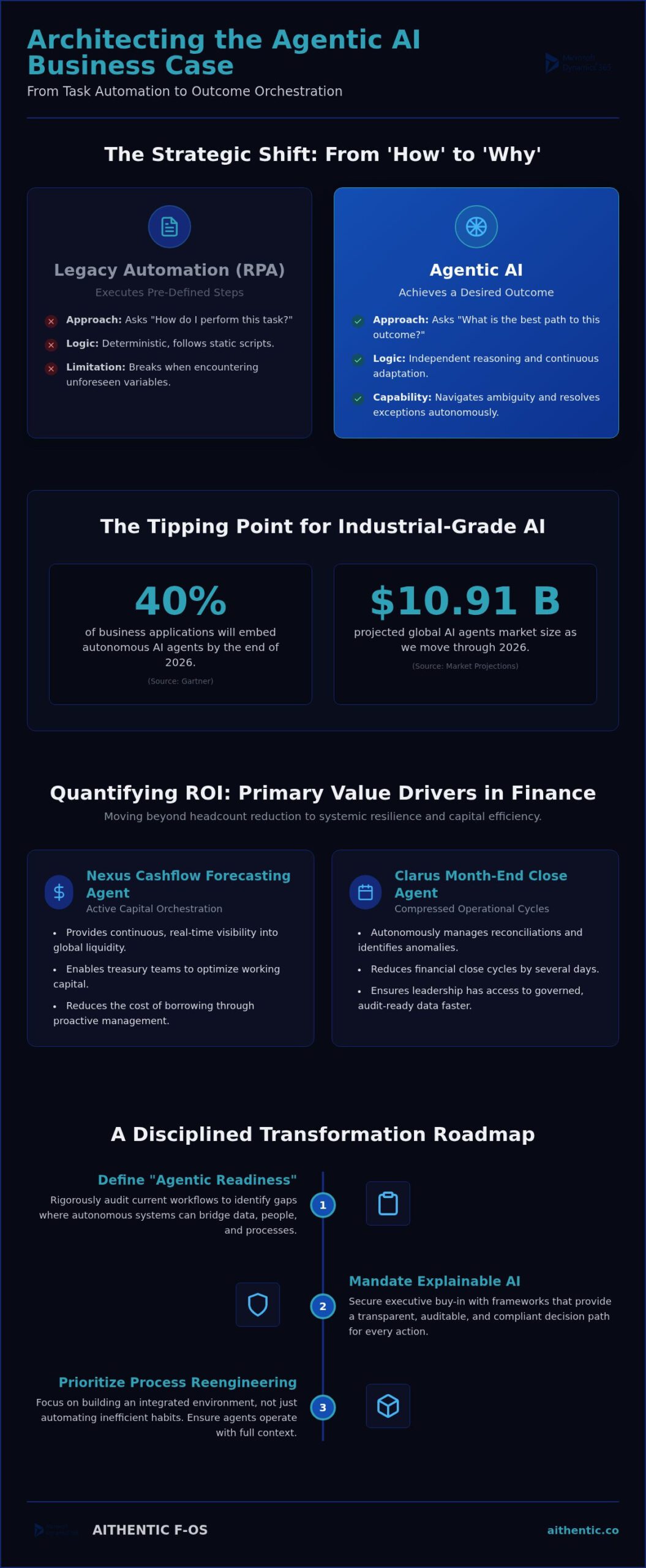
The traditional enterprise paradigm has long prioritized the mechanization of labor through Robotic Process Automation (RPA). This approach focuses on the deterministic execution of pre-defined steps; it is a system of “how” rather than “why.” However, as we move through 2026, the global AI agents market is projected to reach nearly $10.91 billion, signaling a fundamental shift in how corporations perceive value. A credible agentic ai business case is no longer about incremental speed, but about structural autonomy. Gartner projects that by the end of this year, 40% of business applications will embed AI agents capable of specific autonomous tasks, marking the definitive tipping point for industrial-grade systems.
Agentic AI represents a departure from static scripts. These systems are defined by their capacity for independent reasoning, goal-oriented execution, and continuous adaptation. By understanding the foundational concepts of agentic AI, leadership can visualize a system that doesn’t just process data but interprets it to achieve a specific business objective. It is the difference between a tool that follows a map and an agent that finds the destination. This “Agentic Vision” serves as the bedrock of the business case, moving the conversation from software procurement to systemic orchestration.
From Task-Based Execution to Outcome-Based Agency
Legacy automation asks, “How do I perform this specific task?” Agentic architectures ask, “What is the most efficient path to this desired outcome?” This shift is powered by reasoning loops, which are iterative cycles where the agent assesses its environment, plans its actions, and evaluates its success. Unlike RPA, which breaks when it encounters a variable outside its script, an agent uses these loops to navigate ambiguity and resolve exceptions. Agentic AI is the definitive evolution of autonomous enterprise intelligence. It transforms the workforce by offloading the cognitive burden of process management, allowing human capital to focus on high-stakes strategy and creative problem-solving.
The Role of the Strategic Architect
Securing ROI requires more than technology procurement; it demands a comprehensive roadmap for process reengineering. The CFO, acting as the strategic architect, must define “agentic readiness” by identifying where autonomous systems can bridge the gaps between data, people, and processes. This involves a rigorous audit of current workflows to ensure that agents aren’t simply automating inefficient habits. Instead, the focus is on building an integrated environment where agents like Atlas or Nexus can operate with full context. By positioning the finance function as the primary beneficiary of this orchestration, the organization ensures that every deployment is grounded in measurable results and corporate responsibility.
Quantifying the ROI: The Financial Impact of AI Agents
Constructing a robust agentic ai business case requires a fundamental departure from the simplistic labor-reduction metrics of the previous decade. In the current 2026 fiscal environment, executive leadership must prioritize value-added analytics, risk mitigation, and systemic resilience over mere headcount reduction. The true financial impact of autonomous systems lies in their ability to orchestrate complex outcomes that traditional automation simply cannot reach. By moving beyond task-based thinking, organizations unlock significant capital efficiency through real-time liquidity management and compressed operational cycles.
Primary Value Drivers in the Finance Function
The deployment of the Nexus Cashflow Forecasting Agent illustrates this shift toward active capital orchestration. Unlike static models, Nexus provides continuous, real-time visibility into global liquidity, allowing treasury teams to optimize working capital and reduce the cost of borrowing. Similarly, the Clarus Month-End Close Agent addresses the systemic bottleneck of financial reporting. By autonomously managing reconciliations and identifying anomalies, Clarus reduces close cycles by several days, ensuring that leadership has access to governed, audit-ready data much faster than manual processes allow. These gains are compounded by a drastic reduction in error rates within complex budgeting and forecasting cycles, where the cost of a single miscalculation can reach millions in lost opportunity or regulatory penalties.
Agentic AI vs. Traditional Automation (RPA)
A critical component of any ROI analysis is the total cost of ownership. Traditional RPA is fragile. It often requires significant manual intervention whenever a software interface updates or a data format shifts. In contrast, agentic AI demonstrates remarkable resilience. When implementing agentic AI, enterprises benefit from systems that use reasoning loops to navigate ambiguity and adapt to changing regulations. This transition represents a shift from maintaining brittle scripts to governing dynamic intelligence. To understand how your organization can achieve these results, consider exploring a bespoke AI transformation roadmap designed for high-stakes environments.
| Operational Feature | Traditional RPA (Static) | Agentic AI (Dynamic) |
|---|---|---|
| Decision Logic | Pre-defined, linear rules | Goal-oriented, autonomous reasoning |
| Data Processing | Limited to structured inputs | Handles structured and unstructured data |
| Environmental Adaptation | Breaks when variables change | Self-corrects and adapts to new contexts |
The hidden cost of inaction is perhaps the most significant risk in the 2026 market. As 80% of executives increase their investment in these technologies, relying on legacy systems creates a widening gap in operational agility and compliance accuracy. AI agents in finance are dynamic. They ensure that your financial operations remain stable, transparent, and scalable. The choice is no longer between automation and manual work; it’s between static execution and dynamic agency.
The Explainability Mandate: Securing Governance and Trust
For enterprise leaders, the allure of autonomous agency is often tempered by the opacity of the underlying models. In a regulated environment, a “black box” approach is a non-starter. A credible agentic ai business case must prioritize Explainable AI (XAI), which ensures that every decision path is visible, verifiable, and auditable. This level of transparency is not a secondary feature; it is the structural foundation that allows for the integration of autonomous systems into high-stakes financial workflows. Intellectual honesty in reporting requires that an agent can explain its logic, cite its sources, and acknowledge its limitations, thereby transforming raw data into actionable, governed intelligence.
Auditability by Design
Trust is built through transparent reasoning logs that document the intent, context, and execution of every autonomous action. By embedding governance and trust in AI agents, organizations can satisfy the rigorous demands of auditors and regulators alike. Human-in-the-loop (HITL) protocols serve as a critical fail-safe, ensuring that while the agent orchestrates the process, the human expert remains the ultimate arbiter of truth. This collaborative model ensures that every deployment is grounded in corporate responsibility, ethical integrity, and measurable performance, effectively mitigating bias before it can impact the bottom line.
Risk Management in Agentic Ecosystems
Financial forecasting is particularly vulnerable to model drift and hallucinations, where an AI might generate plausible but factually incorrect data. The Aegis Treasury Agent addresses this through real-time risk mitigation, continuously validating its outputs against ground-truth financial data, historical benchmarks, and regulatory constraints. This proactive stance ensures that the system remains stable, secure, and accurate even as market conditions fluctuate or data sources evolve. By maintaining this level of operational rigor, the enterprise protects itself from the reputational and financial damage of unmonitored AI errors. Explainability is the non-negotiable prerequisite for CFO approval in any industrial-grade deployment.
The Implementation Roadmap: Mapping the Transformation
A successful transition to autonomous agency is not a procurement exercise; it is a structural evolution. Organizations that treat this as a mere software upgrade often fail to capture the systemic value promised in their initial agentic ai business case. To avoid the pitfalls of fragmented automation, leadership must prioritize process reengineering before technology deployment. This ensures that agents aren’t simply accelerating legacy inefficiencies but are instead operating within a framework designed for industrial-grade performance, scalability, and security.
The journey begins with identifying high-impact, low-complexity “Quick Wins.” These pilot projects, such as automating specific segments of the month-end close or real-time cashflow forecasting, provide the necessary proof points to justify wider adoption. By establishing a Center of Excellence (CoE), the enterprise creates a dedicated hub for inter-agent orchestration, ensuring that specialized agents like Atlas and Titan communicate seamlessly across the finance function. This centralized governance model maintains the architectural integrity required to manage complex reasoning loops and autonomous decision-making.
Phase 1: Discovery and Strategic Vision
Strategic architects must first map business objectives to specific agentic use cases. This phase involves a rigorous assessment of data maturity and infrastructure resilience to ensure the environment is ready for autonomous systems. By defining precise KPIs for success, such as compressed reporting cycles or improved liquidity ratios, leadership can quantify the value of the transformation. It’s about building a foundation where data, people, and processes are unified under a single, governed vision. To begin this process, organizations should seek expert AI transformation consulting and advisory to align their technical roadmap with their long-term corporate strategy.
Phase 2: Bespoke Solution Development
Moving from a prototype to an industrial-grade deployment requires a disciplined approach to integration. Custom AI agents must be woven into existing enterprise workflows without disrupting critical operations. This phase also demands a focus on the human element, as the workforce must be trained to partner with autonomous systems. Success is found when employees move from manual execution to cognitive partnership, overseeing the agents that handle the operational heavy lifting. This transition ensures that the organization doesn’t just adopt new tools but evolves into a more agile, transparent, and results-oriented enterprise.
AITHENTIC F-OS: Orchestrating the Future of Work
The AITHENTIC F-OS Finance Operating System represents the culmination of this structural evolution. It isn’t a collection of disparate tools, but a unified environment designed to integrate data, people, and processes into a single, governed architecture. By deploying specialized agents, enterprises move beyond the experimental phase of technology into a state of industrial-grade application. This platform provides the necessary infrastructure to support a high-stakes agentic ai business case, ensuring that every autonomous action is grounded in measurable results, corporate responsibility, and systemic integrity.
The Power of Inter-Agent Orchestration
True efficiency in the finance function is achieved through the seamless interaction of autonomous workers. Within the F-OS environment, the Atlas FP&A agent and Nexus Cashflow agent share real-time insights, allowing for a level of predictive accuracy that manual processes cannot match. This is made possible by a governed Agent-to-Agent (A2A) communication layer, which ensures that data remains secure, transparent, and auditable across all functions. When the Clarus Month-End Close agent identifies a reconciliation anomaly, it doesn’t just flag the error; it coordinates with Titan and Aegis to assess tax implications and risk exposure. This orchestration reduces friction, eliminates silos, and compresses operational cycles through unified intelligence. For a deeper examination of how ai agents in finance are transforming treasury, tax, and planning functions, the structural implementation across these domains offers critical insight for enterprise leaders.
Building for the 2027 Planning Cycle
As organizations look toward the 2027 planning cycle, the risk of technological obsolescence becomes a primary concern. Implementing a static system today is a recipe for future failure. AITHENTIC serves as a strategic architect, providing the ongoing AI transformation consulting and advisory necessary to navigate a rapidly shifting regulatory and technical landscape. By establishing a foundation of explainable, governed intelligence now, leadership ensures that their enterprise remains resilient, scalable, and competitive. This is a personality of “intellectual honesty,” valuing the “how” of the process as much as the “what” of the output.
The transition from task-based automation to outcome-based agency is not merely a choice; it’s a requirement for those who intend to lead in the era of autonomous work. Executive leadership must now initiate the roadmap to secure their organization’s future. AITHENTIC stands ready to partner with you, providing the disciplined, results-oriented guidance required to architect a finance function that is both ambitious about the future and deeply disciplined about the present. It’s time to move past the hype and into the era of industrial-grade AI application.
Architecting the Future of Autonomous Finance
Transitioning from static automation to autonomous agency is a foundational change that requires more than technical adoption; it demands a shift in organizational philosophy. By constructing a robust agentic ai business case, finance leaders can move beyond incremental efficiency to achieve systemic orchestration. This evolution is anchored in explainable AI and rigorous governance, ensuring every autonomous action remains auditable, compliant, and aligned with corporate responsibility. You’ve moved past the experimental phase of technology and into the era of industrial-grade application.
The AITHENTIC F-OS Finance Operating System provides the industry-leading framework to integrate data, people, and processes into a unified environment. We specialize in developing bespoke roadmaps for global enterprises, delivering solutions that prioritize transparency and measurable results. Don’t let your transformation be hindered by the limitations of legacy systems or the ambiguity of black-box models. Begin your enterprise transformation with an AITHENTIC AI Roadmap today to secure your position as a strategic architect of the future. The era of autonomous intelligence is here, and your leadership is the catalyst for its success.
Frequently Asked Questions
What is the difference between an AI agent and agentic AI?
Agentic AI describes the systemic capacity for goal-oriented reasoning, whereas an AI agent is the specific entity, such as the Atlas Planning Agent, that executes these functions. While a standard agent might perform a single automated step, agentic systems orchestrate complex, multi-stage workflows by evaluating data and making independent decisions. This distinction is critical for a credible agentic ai business case because it moves the focus from simple task automation to comprehensive, autonomous intelligence.
How do I measure the ROI of an agentic AI deployment?
Measuring the ROI of an agentic AI deployment requires looking past simple headcount reduction to focus on value-added outcomes like compressed month-end cycles, improved liquidity, and risk mitigation. You should quantify the reduction in manual error rates and the increase in working capital efficiency achieved through real-time forecasting. By evaluating these strategic gains, leadership can justify the initial investment through measurable productivity, structural resilience, and long-term operational agility within the broader enterprise environment.
Is agentic AI safe for use in highly regulated financial sectors?
Agentic AI is designed specifically for high-stakes, regulated environments when built upon a foundation of transparency and ethical governance. AITHENTIC F-OS ensures safety by embedding rigorous audit trails and reasoning logs into every autonomous decision path. This approach mitigates the risks associated with opaque “black box” systems, providing the intellectual honesty required for CFO approval. By maintaining human-in-the-loop protocols, organizations ensure that autonomous agency remains a stabilizing force grounded in corporate responsibility and compliance.
How does explainable AI (XAI) differ from standard generative AI?
Explainable AI (XAI) differs from standard generative AI by providing a transparent, auditable trail of the logic used to reach a specific conclusion. While standard models often prioritize the final output over the underlying process, XAI mandates that every decision is traceable back to its source data and reasoning loop. This level of clarity is essential for regulated sectors where an unverified answer is a liability. It transforms AI from a creative engine into an industrial-grade tool for governed financial reporting.
Will agentic AI replace our existing finance team?
Agentic AI doesn’t replace your finance team; it evolves their role from manual execution to strategic oversight. By offloading the cognitive burden of reconciliations and data entry to specialized agents like Clarus, your professionals can focus on high-value analysis and creative problem-solving. This partnership enhances human capability, allowing the workforce to act as strategic architects who govern autonomous systems. It’s a shift from being a processor of data to an orchestrator of enterprise intelligence.
What infrastructure is required to support an agentic AI platform like F-OS?
Supporting a platform like the AITHENTIC F-OS requires a scalable data strategy grounded in infrastructure resilience and secure integration layers. You must ensure your data environment is unified and accessible to allow agents to pull context from across the organization. This involves establishing a Center of Excellence to manage inter-agent orchestration and maintain the architectural integrity of the system. AITHENTIC provides the necessary consulting to assess your readiness and prepare your technical stack for industrial-grade agency.
How long does it take to see results from an agentic AI transformation?
Results from an agentic AI transformation typically emerge in phases, with high-impact “Quick Wins” visible within the first few weeks of a pilot program. For example, automating specific segments of cashflow forecasting can deliver immediate visibility into liquidity. However, a full-scale systemic integration often requires a multi-month roadmap to ensure process reengineering and workforce training are complete. This disciplined approach ensures that short-term gains are backed by a foundation for sustainable, long-term ROI and operational excellence.
Can agentic AI integrate with our existing ERP and data stacks?
The AITHENTIC F-OS is engineered to integrate seamlessly with your existing ERP systems and global data stacks. The platform functions as a sophisticated orchestration layer that sits atop legacy infrastructure, pulling information to inform its reasoning loops without requiring a total system overhaul. This design allows you to strengthen your agentic ai business case by leveraging current investments while adding a layer of autonomous agency. It ensures your data remains a unified asset rather than a fragmented liability.