
Only 19% of accounting firms trust artificial intelligence enough to deploy it with limited human review, according to September 2026 research from Financial Cents. That skepticism is entirely justified. The mainstream push toward ai in accounting has relied heavily on probabilistic, black-box models that falter during external financial audits and violate core Sarbanes-Oxley control standards. You already know the compounding friction: talented finance teams remain bogged down by manual sub-ledger reconciliations, while disconnected ERP silos turn every month-end close into a high-stakes, multi-week scramble.
True operational transformation doesn't come from conversational toys; it requires deterministic, governed agentic systems engineered for high-stakes balance sheets. In this case study, discover how forward-thinking finance leaders deploy explainable multi-agent architectures to compress close cycles into continuous reconciliation, enforce pristine audit trails, and unify disparate systems without data duplication. We'll unpack the concrete architectural blueprints, control environments, and operational frameworks required to build an autonomous, audit-ready enterprise ledger.
Key Takeaways
- Understand why static, rules-based RPA scripts fail under modern transaction complexity and how self-correcting agentic workflows resolve exceptions autonomously.
- Discover how orchestrating multi-agent architectures transforms ai in accounting from unverified experiments into coordinated, deterministic ledger engines.
- Learn the core principles of audit-by-design frameworks that guarantee absolute explainability and align autonomous entries directly with SOX 404 compliance standards.
- Examine an enterprise implementation blueprint that compressed a complex 14-day financial close across disparate ERPs through a structured ninety-day deployment.
- Master a five-step executive evaluation framework to vet intelligence platforms using non-intrusive semantic overlays that bypass disruptive core replatforming.
The Structural Shift: Why Legacy Automation Fails Modern Enterprise Accounting
Enterprise finance has reached the operational limits of scripted automation. For two decades, corporate controllers relied on Robotic Process Automation (RPA) to stitch together disparate financial systems. Yet, traditional bots are blind executors; they follow deterministic, hardcoded rules that fracture whenever an underlying data structure shifts. Autonomous accounting marks the departure from these brittle pathways. Rather than executing unyielding scripts, modern architectures utilize self-correcting cognitive agents capable of interpreting context, remediating exceptions, and preserving accounting logic across evolving enterprise systems.
The historical reliance on legacy accounting automation created a fragile illusion of efficiency. When a vendor modifies an invoice layout, an ERP patch updates a database schema, or a subsidiary records a non-standard currency conversion, static scripts crash. The true operational cost surfaces in shared services centers, where manual teams spend thousands of hours triaging process exceptions under strict reporting deadlines. Managing multi-entity, multi-currency ledger adjustments requires actual cognitive context: evaluating foreign exchange fluctuations, identifying intercompany netting misalignments, and balancing ledgers across jurisdictions. Scripted tools cannot reason through these dimensions, leaving controllers dependent on bloated, manual reconciliation workarounds.
Deconstructing the Fragility of Traditional Financial RPA
Traditional bots fail because they lack semantic comprehension. When an operational sub-ledger updates its formatting, a deterministic RPA script cannot adapt; it simply halts execution. This brittleness demands persistent developer intervention to rewrite scripts after every ERP patch or interface modification. Compounding the issue, process exceptions cascade across the organization. When an automation fails silently, reconciliation delays ripple into downstream reporting cycles, forcing senior accountants to act as human middleware instead of strategic advisors.
Moving Beyond Probabilistic Black Boxes to Deterministic Ledgers
Deploying generative models directly to corporate ledgers introduces severe operational hazards. Large language models operate on probabilistic token prediction, a mechanism fundamentally incompatible with double-entry bookkeeping. Hallucinations on a balance sheet mean restatements, legal exposure, and failed controls. The deployment of ai in accounting demands a deterministic architecture that guarantees mathematical verification:
- Deterministic verification layers: Mathematical engines that execute strict double-entry balancing rules before any journal entry posts.
- Granular lineage preservation: An auditable trace recording every prompt, contextual source, and sub-agent decision path back to the originating transaction.
- Constrained execution boundaries: Operational guardrails that prevent autonomous agents from creating unreconciled accounts or adjusting control totals without explicit authorization.
Deploying ai in accounting successfully hinges on this structural boundary. By separating cognitive reasoning from transaction execution, finance executives eliminate probabilistic risk, establish absolute data lineage, and ensure every calculated balance remains fully verifiable for internal and external auditors alike.
Architectural Blueprints: Deploying Multi-Agent Systems Across the Ledger
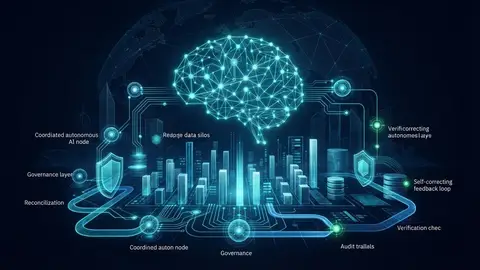
Enterprise ledgers don't suffer from an absence of data; they suffer from fragmented context. Replacing brittle scripts requires a decentralized multi-agent architecture where discrete cognitive agents oversee specific financial domains. Rather than funneling petabytes into slow, centralized data lakes, autonomous orchestration platforms sit directly on top of hybrid ERP stacks. In this modern implementation of ai in accounting, specialized agents negotiate balances, match sub-ledgers, and flag anomalies across accounts asynchronously, transforming disjointed records into a synchronized financial truth.
Within this ecosystem, specialized agents operate with dedicated operational purviews:
- Close and Reconciliation: The Clarus Month-End Close Agent executes balance sheet substantiation and transaction matching across local general ledgers.
- Compliance and Regulation: The Titan Tax & Compliance Agent continuously audits transaction paths against statutory reporting criteria.
- Forecasting and Cash Management: The Nexus Cashflow Forecasting Agent models liquidity fluctuations by synthesizing real-time receivables and payables data.
Sub-Ledger Ingestion and Autonomous Account Matching
Disparate billing engines, regional ERP instances, and banking gateways generate transaction volumes that quickly overwhelm manual teams. Modern multi-agent design utilizes high-precision entity resolution to match records across diverse data structures. Instead of halting over mismatched currency codes or trailing decimals, agents calculate confidence scores, resolve intra-company transfers, and balance sub-ledgers against central accounting records in real time. As detailed in academic research on real-world applications of financial intelligence, this shifts accounting personnel from transactional processors to strategic reviewers who evaluate edge cases.
Continuous Close Orchestration and Variance Anomaly Detection
Periodic close cycles create artificial bottlenecks. Governed architectures replace this monthly crunch with continuous transaction verification, running reconciliations continuously in the background. Anomaly detection models spot unusual margin swings, duplicate entries, or suspicious vendor modifications as transactions post, preventing month-end surprises. Orchestration environments like AITHENTIC F-OS unify these workflows across fragmented systems, executing continuous close routines without data duplication. For leaders ready to eliminate reconciliation backlogs, deploying a unified operational layer represents the most viable path toward continuous accounting.
The Audit-by-Design Imperative: Governance, Explainability, and SOX Controls
Autonomous financial execution without verifiable governance is corporate negligence. Internal Control over Financial Reporting (ICFR) demands absolute transparency, making black-box machine learning models non-viable for regulated ledgers. Under Sarbanes-Oxley Section 404, finance executives bear personal legal liability for internal controls. Applying ai in accounting requires an audit-by-design posture where every automated debit, credit, and adjusting entry includes mathematically provable context. Automated systems must prove not just what balance was posted, but precisely how and why that specific determination was reached.
Audit readiness relies on cryptographic logging mechanisms embedded within the orchestration fabric. These immutable append-only logs capture every prompt modification, source document hash, and sub-agent state transition. If an algorithm proposes an accrual adjustment, it attaches a permanent cryptographic signature that prevents retroactive tampering. External auditors don't have to conduct extensive, destructive sampling across raw tables; they simply inspect cryptographically verified transaction graphs that substantiate mathematical accuracy from source invoice to trial balance.
Eliminating the Black Box via Transparent Calculation Trees
Probabilistic opacity has no place on a balance sheet. Enterprise architectures replace conversational ambiguity with deterministic calculation trees that map every journal entry directly to source data, accounting standards, and tax rules. Autonomous systems generate natural language provenance side-by-side with balance calculations, allowing internal controllers and PCAOB-bound external auditors to review the underlying arithmetic instantly. Implementing these transparent pathways aligns with established best practices for deploying explainable AI solutions for regulated industries, debunking the myth that enterprise automation must sacrifice transparency for speed.
Configuring Human-in-the-Loop Thresholds and Segregation of Duties
Deploying ai in accounting doesn't mean removing corporate oversight. It establishes strict segregation of duties between autonomous executors and human sign-offs through systematic operational thresholds:
- Materiality routing: Routing entries exceeding defined dollar thresholds or qualitative risk tolerances directly to senior controllers for explicit approval.
- Variance escalation: Pausing transaction chains when cross-ledger variances exceed historical confidence intervals, preventing error propagation.
- Bounded authority rules: Enforcing strict separation where agents can propose balancing entries, but cannot approve their own high-value postings.
These tiered approval workflows bridge autonomous speed with fiduciary control. Grounding automated ledger actions in comprehensive frameworks for ai model risk management in finance ensures that modern multi-agent systems maintain complete compliance with existing SOX 404 mandates.
Case Study: How an Enterprise Accelerated Month-End Close via Governed Agents
Consider the operational friction inside a multinational logistics provider operating across three distinct ERP systems: SAP S/4HANA, Oracle NetSuite, and Microsoft Dynamics. Each fiscal period culminated in an exhaustive, fourteen-day financial close. Regional finance teams spent hundreds of hours extracting flat files, hand-keying intercompany balances, and wrestling with disjointed spreadsheets. By shifting from reactive data manipulation to governed agentic execution, this global organization proved how modern deployments of ai in accounting can compress reporting cycles while establishing flawless internal controls.
The Baseline Challenge: Fragmented Systems, Disparate ERPs, and Burnout
The enterprise faced compounding structural failure points. Operating three unintegrated ERP instances forced regional accounting teams to manually reconcile over eight hundred balance sheet accounts every month. This friction caused persistent staff turnover during quarter-end reporting peaks and created severe audit vulnerabilities. Late, undocumented manual adjusting entries regularly triggered external audit testing flags, leaving corporate controllers exposed to heightened scrutiny under SOX 404 control reviews.
The Architectural Intervention: Deploying Clarus and Titan Agents
Rather than undertaking a multi-year, eight-figure ERP consolidation, the organization executed a structured ninety-day rollout of specialized financial agents. They deployed the Clarus Month-End Close Agent directly across operational sub-ledgers, allowing it to autonomously balance transaction streams, match open items, and generate provable journal entries. Concurrently, the organization activated the Titan Tax & Compliance Agent to enforce cross-border statutory compliance and intercompany tax rules across twelve foreign subsidiaries. Both systems operated under the governance framework established for custom AI agents for risk and compliance, guaranteeing continuous human oversight on entries exceeding material thresholds.
Quantifiable Outcomes: Close Compression and Audit Optimization
The operational results established a new institutional benchmark for financial efficiency:
- Drastic cycle compression: The month-end close dropped from fourteen days down to continuous daily reconciliation, culminating in a two-day ledger sign-off.
- Defect elimination: The organization recorded a ninety percent reduction in manual reconciliation exceptions and zero external audit findings during year-end evaluations.
- Strategic talent redeployment: Controllers shifted from manual data aggregation to strategic capital allocation and working capital optimization.
This implementation proves that disciplined, governed ai in accounting transforms the finance office from an operational cost center into a strategic engine. To architect a similar transition for your multi-entity finance stack, consult with the enterprise architects at AITHENTIC to deploy tailored agentic workflows across your ledgers.
The 2026 Executive Roadmap: Evaluating and Integrating AI Accounting Platforms
Enterprise modernization fails when technological architectures demand destructive rip-and-replace migrations. Finance leaders evaluating platforms for ai in accounting must look past cosmetic interfaces and scrutinize the underlying delivery model. Strategic organizations prioritize non-intrusive semantic overlays over disruptive replatforming. These sovereign layers sit directly atop established ERPs, extracting transactional context, executing complex calculations, and writing balanced entries back through secure APIs without modifying underlying core schemas.
To navigate this transition with discipline, CFOs should apply a structured five-step decision framework during vendor diligence:
- Validate architectural coexistence: Confirm the platform acts as an intelligent overlay rather than demanding costly ERP consolidation.
- Audit algorithmic determinism: Ensure mathematical verification layers operate independently of probabilistic language generation.
- Enforce data sovereignty: Verify contractual commitments that enterprise financial records are never used to train public models.
- Map control alignment: Match platform audit trails directly to internal ICFR and external SOX 404 mandates.
- Define supervisory protocols: Establish clear change management programs that train accounting personnel in agent governance.
Vetting for Enterprise Rigor: Core Evaluation Criteria
Due diligence requires strict technical validation. Platforms must demonstrate independent SOC 1 Type II and ISO 27001 certifications alongside compliance with regional data residency laws. Leadership must ask clear questions: Does the system use unconstrained completions, or does it enforce verifiable calculation trees? Enterprise deployment requires certified API interoperability across SAP, Oracle, and NetSuite environments to preserve balance integrity without relying on custom middleware.
Formulating the Implementation and Coexistence Strategy
Sustainable adoption avoids big-bang rollouts. Organizations should target high-volume, rules-heavy reconciliation workflows first, using isolated pilots to validate accuracy before expanding across the general ledger. As controllers review flagged exceptions, their inputs create active feedback loops that calibrate confidence thresholds and improve autonomous accuracy. Partnering with dedicated enterprise AI transformation consulting specialists gives finance teams the structural scaffolding necessary to transition staff from manual reconcilers into authoritative supervisors of agentic systems.
Architecting the Autonomous, Audit-Ready Future of Finance
The operational paradigm for corporate controllers has permanently shifted. Treating automation as a patchwork of brittle scripts or risky, probabilistic experiments is no longer acceptable for high-stakes ledgers. True competitive advantage stems from governed agentic execution. Deploying ai in accounting now demands deterministic precision, continuous transaction verification, and complete audit-by-design controls embedded directly into daily workflows.
Achieving this level of continuous performance doesn't require dismantling your enterprise core. With the AITHENTIC F-OS Finance Operating System, finance organizations deploy specialized agents like the Clarus Month-End Close Agent and Titan Tax & Compliance Agent directly over existing ERP landscapes. This modular, non-intrusive approach eliminates reconciliation backlogs, guarantees mathematical lineage for every adjustment, and protects audit integrity across global entities. The path from multi-week manual closes to autonomous, explainable continuous reconciliation is already established. Schedule an architectural consultation for AITHENTIC F-OS to transform your enterprise accounting operations.
Frequently Asked Questions
How does AI in accounting differ from traditional robotic process automation?
Traditional robotic process automation relies on static, rule-based scripts that break whenever an invoice layout, data field, or system schema changes. Modern ai in accounting utilizes autonomous agents capable of semantic reasoning. These cognitive systems interpret unstructured documents, self-correct minor variances, and coordinate complex multi-step accounting workflows across ledgers rather than merely repeating pre-recorded keystrokes.
Can autonomous AI agents handle complex general ledger adjustments without human intervention?
Agents handle routine adjustments autonomously within tightly configured materiality boundaries and predefined confidence scores. When transactions involve non-standard estimates, cross-border tax implications, or values exceeding defined risk thresholds, the system flags the item. It generates the proposed double-entry calculation along with full supporting context, routing the adjustment directly to a controller for mandatory human review.
What controls prevent artificial intelligence systems from hallucinating journal entries?
Enterprise platforms prevent hallucinations by enforcing a strict separation between cognitive reasoning models and transaction execution engines. Automated postings must pass through deterministic mathematical layers that enforce balanced debits and credits, validate source document hashes, and verify chart-of-accounts mapping. An agent cannot post an unverified token prediction directly to a general ledger.
How do auditors evaluate and verify financial statements processed by autonomous agents?
Auditors evaluate agentic accounting through deterministic calculation trees and immutable cryptographic logs. Rather than relying on periodic manual sampling, auditors inspect permanent audit trails detailing the exact inputs, regulatory rules, and logic paths used for every entry. This verifiable lineage aligns directly with PCAOB standards for evaluating automated tools and data reliability.
Is it necessary to replace our legacy ERP to deploy modern accounting agents?
Core ERP replatforming isn't required. Governed agentic architectures operate as non-intrusive semantic overlays that sit directly on top of existing platforms like SAP, Oracle, and NetSuite. Systems like the AITHENTIC F-OS Finance Operating System interact through secure enterprise APIs, synchronizing ledgers and reconciling balances without disrupting underlying enterprise databases or historical records.
How does agentic accounting software maintain compliance with Sarbanes-Oxley requirements?
Compliance is maintained by embedding Internal Control over Financial Reporting (ICFR) rules directly into agent execution parameters. The architecture enforces digital segregation of duties, ensuring agents cannot unilaterally approve their own high-value transactions. Every automated decision generates timestamped, tamper-proof logs, satisfying Section 404 mandates for clear operational control and complete auditability.
What specific skill sets do corporate controllers need to effectively supervise AI agents?
Controllers are transitioning from manual ledger processors to algorithmic supervisors. Effective oversight requires proficiency in setting materiality thresholds, interpreting automated anomaly alerts, and auditing algorithmic calculation paths. Finance leaders must also master exception-handling protocols, ensuring that human professional skepticism remains the final authority for high-risk judgments in advanced ai in accounting environments.