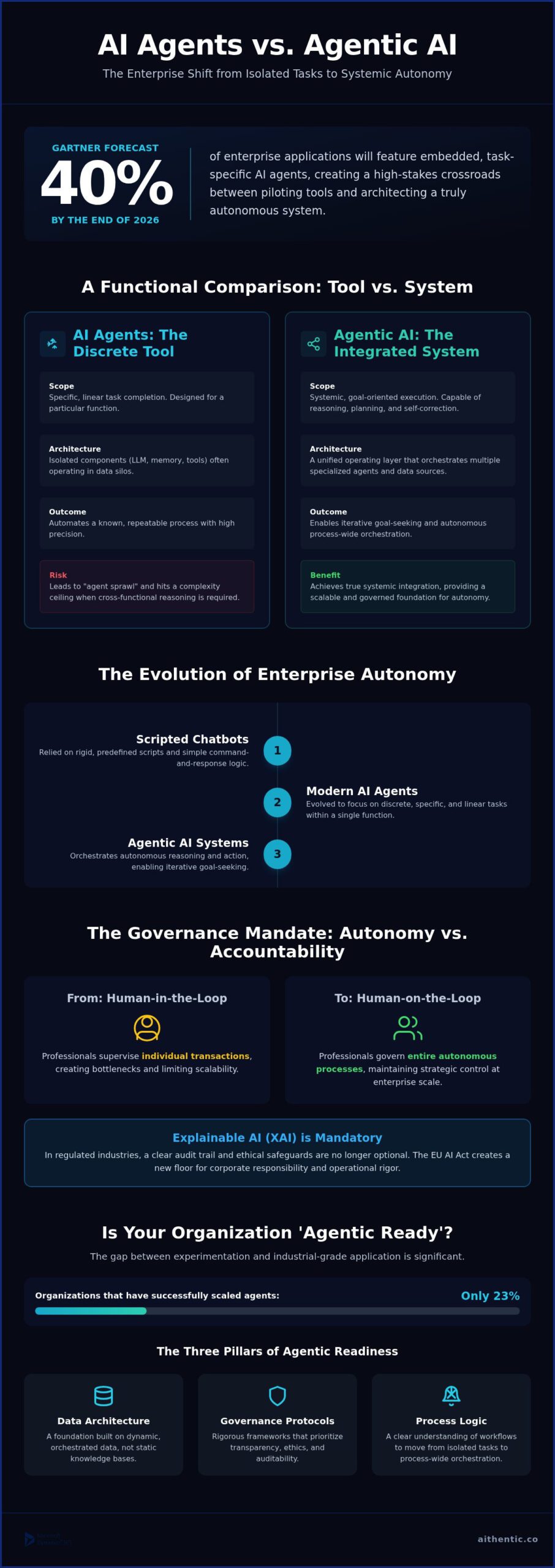
Gartner forecasts that 40% of enterprise applications will feature embedded task-specific AI agents by the end of 2026, yet a profound gap remains between piloting a tool and architecting a system. Most executive leaders now face a high-stakes crossroads, struggling to reconcile the promise of autonomous efficiency with the necessity of ethical governance, structural reliability, and measurable results. You’ve likely felt the fatigue of a landscape where terminology evolves faster than your team can scale a proof-of-concept. It’s natural to hesitate before deploying opaque systems into the complex, regulated environments that define your business.
This guide provides the visionary confidence and pragmatic clarity required to distinguish between ai agents vs agentic ai. We reject the superficial allure of disconnected bots in favor of an integrated, foundational approach to enterprise autonomy. You’ll gain a precise taxonomy for your 2026 investment strategy, a framework for governing autonomous workflows, and a roadmap for transitioning from isolated tasks to process-wide orchestration. By prioritizing transparency and operational rigor, we help you move past experimentation into the era of industrial-grade application.
Key Takeaways
- Distinguish between isolated automation and systemic autonomy to move beyond superficial bot deployment into active, goal-oriented execution.
- Understand the architectural nuances of ai agents vs agentic ai to ensure your infrastructure supports iterative reasoning rather than just linear task completion.
- Implement rigorous governance frameworks that prioritize Explainable AI (XAI) to meet the stringent audit requirements of regulated enterprise environments.
- Discover how the AITHENTIC F-OS orchestrates specialized agents like Atlas and Nexus to transform fragmented accounting tasks into unified, autonomous finance operations.
- Evaluate your organization’s agentic readiness to build a scalable foundation for long-term operational rigor and measurable ROI.
Beyond the Bot: Why the Distinction Matters in 2026
The era of generative AI was characterized by content creation; however, 2026 marks a definitive pivot toward action execution. We’ve moved past the novelty of text generation into a period of systemic integration, where the value of a system is measured by its ability to complete complex workflows autonomously. For executive leadership, understanding the nuances of ai agents vs agentic ai isn’t a semantic exercise. It’s a fundamental requirement for securing investment ROI and ensuring that technology serves the organization’s long-term strategic goals. This transition demands a move from isolated automation to a more integrated, foundational approach to business logic.
CFOs and CTOs now demand more than “black box” automation. They require systems that provide explainability, scalability, and security. In this high-stakes environment, “Agentic Readiness” becomes the prerequisite for enterprise scale. It’s a comprehensive assessment of whether an organization’s data architecture, governance protocols, and process logic are prepared to support autonomous reasoning. Without this foundation, individual AI proofs-of-concept remain isolated, failing to deliver the process-wide orchestration necessary for significant EBIT impact. Only 23% of organizations have successfully scaled agents in at least one function, highlighting the gap between experimentation and industrial-grade application.
The Evolution of Autonomy
The journey toward enterprise autonomy began with simple chatbots that relied on rigid scripts, eventually evolving into the modern AI agent, which focuses on specific, linear tasks. While an agent is a discrete entity designed for a particular function, “agentic” describes a systemic capability for reasoning, planning, and self-correction. Agentic AI is the systemic orchestration of autonomous reasoning and action. This shift from entity-based tools to capability-based systems allows for iterative goal-seeking rather than simple command-and-response cycles, transforming how businesses approach complex problem-solving.
The 2026 Enterprise Mandate
As of August 2, 2026, obligations for high-risk AI systems under the EU AI Act have created a new floor for corporate responsibility and operational rigor. Regulated industries can no longer tolerate unmanaged, isolated bots that lack a clear audit trail or ethical safeguards. We’re witnessing a mandatory transition from “human-in-the-loop” oversight to “human-on-the-loop” governance. In this model, professionals supervise entire autonomous processes rather than individual transactions, maintaining strategic control while allowing the system to handle complex execution with transparency.
AITHENTIC defines “Authentic AI” as a commitment to intellectual honesty and structural transparency. We believe that true autonomy requires more than just code; it requires a disciplined framework that prioritizes ethical governance and predictable performance. By focusing on the structural implementation of agentic models, we help enterprises bridge the pilot-to-production gap. Our approach ensures that every claim of innovation is backed by a robust description of its structural implementation, positioning the brand as a stabilizing force in a rapidly evolving technological sector.
AI Agents vs. Agentic AI: A Functional Comparison
To understand the functional divergence of ai agents vs agentic ai, one must look beneath the interface to the underlying architecture. While an AI agent operates as a discrete functional unit, agentic AI functions as a unified operating layer. This difference isn’t merely academic; it determines whether your enterprise experiences “agent sprawl” or achieves systemic integration. By moving from static knowledge bases to dynamic data orchestration, agentic models allow for a more resilient, scalable, and governed infrastructure. This shift is essential for organizations that prioritize measurable results over industry hype.
Anatomy of an AI Agent
An AI agent typically consists of four foundational pillars: a Large Language Model for processing, a memory module for context, and a suite of tools for execution. These components allow task-specific agents, such as Clarus for month-end close or Titan for tax compliance, to automate specialized workflows with high precision. However, these isolated agents often hit a complexity ceiling. They excel at linear task completion but struggle when a process requires cross-functional reasoning or access to data outside their immediate silo. Without a broader architecture, these tools remain fragmented, forcing human operators to act as the primary bridge between disconnected bots.
The Agentic AI Ecosystem
Contrast this with Agentic AI systems, which prioritize the orchestration of multiple agents toward a high-level goal. In this model, the system moves from linear execution to iterative goal-seeking. It manages inter-agent communication (A2A) and data orchestration dynamically, ensuring that the right agent is deployed for the right sub-task at the right time. A central orchestrator, like the AITHENTIC F-OS, provides the necessary governance to control emergent behavior, preventing the system from deviating from established business logic. This unified approach eliminates the risk of unmanaged automation, replacing it with a scalable foundation for enterprise autonomy. For organizations seeking to move beyond experimental bots, evaluating your current architectural readiness is the first step toward true operational rigor.
The Governance Mandate: Autonomy vs. Accountability
The “Black Box” problem represents a significant barrier to enterprise adoption, particularly where fiduciary responsibility is paramount. While individual bots might automate simple data entry, they often fail the rigorous audit requirements of global finance because their decision-making logic remains opaque. In the debate of ai agents vs agentic ai, the latter must be built upon a foundation of Explainable AI (XAI) to move beyond superficial automation. We advocate for “Auditability by Design,” a structural engineering principle where every autonomous action is logged, indexed, and justified against established business rules. This approach transforms a liability into a stabilizing force for the organization.
Recent guidance from the U.S. GAO on AI Agents underscores the necessity of managing the challenges and policy implications of these autonomous systems. For the AITHENTIC F-OS, this means providing governed, transparent intelligence that allows leadership to trace the “why” behind every financial forecast or treasury movement. Intellectual honesty requires that we acknowledge the risks of autonomy while providing the structural implementation to mitigate them. By prioritizing clarity over industry hype, we ensure that every claim of innovation is backed by a verifiable audit trail.
Risk Mitigation in Agentic Architectures
Autonomous financial forecasting carries the inherent risk of hallucination, where a system generates plausible but incorrect data. To counter this, we implement guardrails that define the boundaries of agentic reasoning without stifling its ability to find optimal solutions. For example, the Aegis Treasury Agent utilizes real-time risk mitigation protocols to monitor liquidity, market volatility, and compliance thresholds. It doesn’t just execute trades; it justifies them within a risk-averse framework, ensuring that systemic autonomy never compromises organizational security or ethical standards.
Regulatory Compliance for 2026
Navigating the fragmented legal landscape of 2026 requires more than just technical skill. With the EU AI Act’s high-risk obligations in effect since August 2026 and the Colorado AI Act active as of February 2026, compliance is now a matter of structural integrity. Explainability is the only path to CFO approval for agentic systems, as it transforms a hidden process into a verifiable asset. We help organizations create a transformation roadmap that prioritizes ethical governance, ensuring that innovation remains grounded in corporate responsibility and measurable results. This disciplined approach allows for the deployment of sophisticated systems that are both ambitious and deeply responsible.
Agentic Architectures in Finance: From Task to Orchestration
Finance departments have historically relied on isolated automation, deploying disconnected bots to handle repetitive data entry or simple invoice processing. This “bot-based” approach often creates functional silos, requiring manual intervention to bridge the gap between accounts payable, treasury, and strategic planning. In the evolving landscape of ai agents vs agentic ai, the shift toward orchestration allows for a unified business logic that governs every transaction, reconciliation, and forecast. While individual agents might offer a 20% efficiency gain in specific, narrow tasks, a fully integrated agentic system can drive up to 80% efficiency across entire processes by eliminating the friction of manual data handoffs and human-led coordination.
The AITHENTIC F-OS Finance Operating System serves as the structural foundation for this transformation, acting as a Strategic Architect for the modern enterprise. It doesn’t merely host tools; it orchestrates specialized agents into a cohesive, high-performance ecosystem. For instance, Atlas (FP&A) and Nexus (Cashflow Forecasting) don’t operate in vacuums. They collaborate, exchange data, and refine their outputs based on shared organizational goals. When Nexus identifies a potential liquidity gap, Atlas immediately adjusts budget scenarios to mitigate the risk, ensuring that every decision is grounded in real-time, cross-functional intelligence. This level of systemic integration provides the operational rigor required by executive leadership. Organizations evaluating commercial fintech AI agent platforms will find that this orchestrated approach represents the definitive standard for enterprise-grade financial intelligence.
Orchestrating the Modern Ledger
Modern finance requires a system that manages document flow, budgeting, and reconciliation simultaneously rather than sequentially. Moving beyond manual reporting, agentic insights provide a continuous, live view of organizational health that is both accurate and explainable. The Clarus Month-End Close Agent serves as a critical component in this architecture, automating complex reconciliations and ensuring that the ledger reflects the most current financial reality with absolute precision. This transition from manual oversight to systemic autonomy reduces errors, accelerates closing cycles, and enhances overall data integrity.
Strategic Planning with Agentic Foresight
Strategic planning often suffers from static models that fail to account for rapid market volatility or internal shifts. By using Atlas, leadership can execute multi-scenario planning with unprecedented speed, allowing for more ambitious and disciplined decision-making. These agentic systems synthesize internal performance data with external market signals, providing a level of foresight that traditional tools simply cannot match. As these systems mature, the role of the finance professional evolves. Finance teams transition from data processors to agentic system governors, overseeing the logic, ethics, and performance of the autonomous ecosystem. To begin this transition, you can explore our AI Transformation Consulting to align your organizational architecture with your long-term strategic vision.
The Strategic Path Forward: Transitioning to Agentic Models
Transitioning to an autonomous enterprise isn’t merely a matter of software acquisition; it’s a process of deep structural evolution. To succeed, organizations must move past the “pilot purgatory” of isolated prototypes into the era of industrial-grade agentic applications. This requires a rigorous assessment of your “Agentic Readiness” score, a metric that evaluates data integrity, process maturity, and governance frameworks. Understanding the architectural divide of ai agents vs agentic ai allows leadership to prioritize systemic integration over fragmented automation, ensuring that every technological investment serves a broader strategic objective.
The AITHENTIC F-OS provides the necessary foundation for this future of work. It acts as a stabilizing force that integrates people, data, and processes into a unified system of intelligence. By moving from disconnected bots to a governed operating system, enterprises can achieve the scalability and security required for high-stakes, regulated environments. Our methodology encompasses consulting, process reengineering, and deployment, ensuring that your transition to autonomy is both ambitious and deeply disciplined.
Building the AI Transformation Roadmap
A successful transformation requires a methodical, three-phase approach that aligns technical implementation with business utility. We guide organizations through a logical progression from identifying needs to visualizing comprehensive solutions:
- Phase 1: Identifying high-impact agentic use cases, specifically within FP&A and Compliance, where the ROI is measurable and immediate.
- Phase 2: Establishing a robust data strategy and ensuring systemic integration across existing enterprise infrastructure.
- Phase 3: Executing the bespoke deployment of customized AI agents that operate within the governed framework of the F-OS.
Partnering for Authentic Intelligence
Bespoke solutions inherently outperform off-the-shelf AI agents because they’re engineered to reflect your specific business logic and regulatory constraints. Off-the-shelf tools often lack the transparency required for auditability, whereas AITHENTIC’s commitment to secure, scalable, and explainable systems ensures that innovation never comes at the cost of integrity. We provide the intellectual honesty and operational rigor that executive leaders demand in a high-stakes environment. To begin architecting your autonomous foundation, schedule your AI Transformation Advisory session with AITHENTIC and move beyond the experimental phase of technology.
Architecting the Autonomous Enterprise
The transition from experimental automation to industrial-grade autonomy marks a definitive pivot in enterprise strategy. It requires a move beyond the superficial allure of disconnected tools toward a system that prioritizes structural integrity, ethical governance, and measurable results. Understanding the functional divergence of ai agents vs agentic ai is no longer a choice but a mandate for leaders who seek to build a scalable, governed foundation for the future of global business. This evolution demands a disciplined focus on how systems plan, reason, and self-correct within complex, high-stakes environments.
The AITHENTIC F-OS stands as the definitive governed operating system for enterprise finance, providing the structural implementation required for expert advisory in regulated industries globally. By focusing on intellectual honesty and operational rigor, we help you deploy explainable, industrial-grade agentic solutions that transform fragmented tasks into unified, high-performance workflows. You’re invited to architect your future with AITHENTIC’s AI Transformation Consulting to secure your organization’s position in this new landscape. The journey toward process-wide orchestration is complex, but it remains the most reliable route to predictable performance and organizational evolution. We’re ready to guide your transition with visionary confidence and pragmatic reliability.
Frequently Asked Questions
What is the primary difference between an AI agent and agentic AI?
An AI agent is a specialized component designed for a specific task, while agentic AI refers to the broader, orchestrated system that plans and reasons across multiple agents. The distinction between ai agents vs agentic ai is fundamentally about the shift from isolated automation to process-wide autonomy. While an agent completes a linear command, an agentic system manages complex, iterative workflows by coordinating various specialized entities to achieve a high-level organizational goal.
How does agentic AI improve upon traditional workflow automation?
Agentic AI moves beyond the rigid, “if-this-then-that” logic of traditional workflow automation by introducing autonomous reasoning and self-correction. Traditional systems break when they encounter data outside their narrow parameters, whereas agentic architectures can adapt to volatility, synthesize disparate data points, and refine their actions in real-time. This transition allows enterprises to automate high-stakes processes that require judgment, planning, and cross-functional coordination rather than just repetitive, manual tasks.
Why is explainability critical for AI agents in the finance sector?
Explainability is essential because financial leaders must justify every autonomous decision to auditors, regulators, and stakeholders. In a regulated environment, a “black box” system creates unacceptable risk; however, explainable AI provides a clear audit trail for why a specific forecast or transaction occurred. This transparency ensures compliance with the EU AI Act and global enterprise regulations, transforming AI from an opaque liability into a stable, governed asset for the modern finance department.
Can I build an agentic system using existing LLM frameworks?
While existing LLM frameworks provide the foundational reasoning capabilities, building a true agentic system requires a sophisticated orchestration layer that manages memory, tools, and inter-agent communication. Simply utilizing LLMs as standalone wrappers is insufficient for industrial-grade applications. To achieve systemic autonomy, organizations must architect a unified environment, such as the AITHENTIC F-OS, which provides the necessary governance and integration to move from simple prompt-response cycles to complex, multi-agent process execution.
What are the security risks of deploying autonomous agentic architectures?
The primary security risks include unmanaged emergent behavior, data leakage, and the potential for hallucinations in high-stakes financial forecasting. Without rigorous guardrails, autonomous systems might deviate from established business logic or access sensitive data across silos. Mitigating these risks requires a zero-trust architecture and real-time monitoring. We prioritize “Auditability by Design” to ensure that every action remains within defined ethical and operational boundaries, protecting the enterprise from systemic vulnerabilities.
How does the AITHENTIC F-OS govern multiple specialized AI agents?
The AITHENTIC F-OS acts as a central orchestrator that manages, monitors, and synchronizes specialized agents like Atlas for FP&A and Nexus for cashflow forecasting. It provides a unified governance layer that enforces business rules, manages inter-agent data handoffs, and ensures all actions are explainable. This systemic approach prevents the fragmentation of “agent sprawl,” allowing multiple autonomous entities to collaborate within a single, secure environment that maintains absolute operational rigor.
What is the “Human-on-the-loop” model in agentic systems?
The “Human-on-the-loop” model represents a shift from manual intervention to strategic supervision. Instead of being involved in every transaction, human professionals oversee the entire agentic system, intervening only when the architecture identifies a high-risk anomaly or requires strategic judgment. This model preserves human authority while allowing the system to handle the complexity of execution, ensuring that the enterprise benefits from autonomous speed without sacrificing corporate responsibility or ethical oversight.
How long does an enterprise AI transformation to an agentic model take?
An enterprise transformation typically follows a phased roadmap that can span several months, depending on the organization’s “Agentic Readiness.” Initial high-impact use cases, such as automating month-end close or cashflow forecasting, can often be deployed within weeks. However, full systemic integration, encompassing process reengineering, data strategy, and bespoke agent deployment, requires a disciplined, long-term commitment to ensure the resulting architecture is secure, scalable, and capable of delivering measurable EBIT impact across the global organization.