
The era of the experimental AI chatbot is over, replaced by an industrial-grade necessity for structural financial intelligence. You likely recognize that “black box” models and fragmented automation are no longer sufficient for an enterprise operating under the scrutiny of the EU AI Act or California’s evolving transparency mandates. The friction of legacy integration and the looming risk of non-compliance demand a more disciplined, foundational approach to commercial fintech ai agent platforms 2025 that prioritizes scalability, security, and functional impact. We understand that your objective is not merely to keep pace with innovation, but to build a system defined by order, control, and predictable performance.
This article provides the strategic blueprint to navigate the shift from simple automation to orchestrated agentic systems that deliver explainable, enterprise-grade financial intelligence. We will demonstrate how to architect a secure, governed finance operating system that prioritizes clarity, integrity, and ethical governance. You’ll discover a clear roadmap for transformation that secures measurable productivity gains in month-end close and forecasting, moving your organization from AI-curious to truly AI-enabled through rigorous operational excellence and systemic integration.
Key Takeaways
- Understand the critical evolution from basic task automation to agentic orchestration, moving beyond rigid RPA toward systems that autonomously manage complex financial workflows.
- Learn how to evaluate commercial fintech ai agent platforms 2025 based on their capacity for systemic integration, operational rigor, and explainable intelligence.
- Discover how to align your AI strategy with the 2025 regulatory landscape by prioritizing platforms that offer inherent auditability and ethical governance.
- Identify the essential phases of a secure transformation roadmap, ensuring your transition from legacy architecture to a modern finance operating system is disciplined and scalable.
- Explore how specialized agents for FP&A, cashflow, and compliance provide the modularity required to achieve measurable gains in forecasting accuracy and month-end efficiency.
The 2025 Paradigm Shift: From Task Automation to Agentic Orchestration
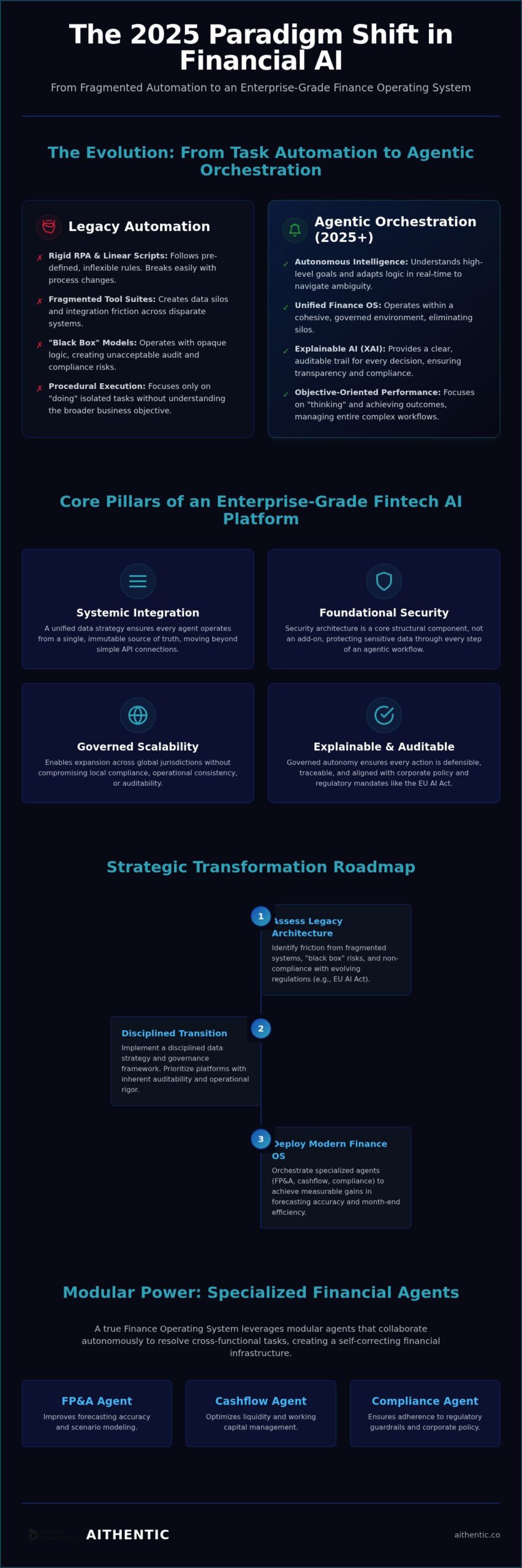
The financial sector has moved beyond the era of superficial automation. In 2025, the focus has shifted from automating isolated tasks to orchestrating entire functional ecosystems. While traditional Robotic Process Automation (RPA) relied on rigid, linear scripts to execute repetitive actions, modern commercial fintech ai agent platforms 2025 utilize autonomous intelligence to navigate ambiguity. These systems don’t just follow instructions; they evaluate context, prioritize outcomes, and adjust their logic in real-time. This transition marks the rise of the Finance Operating System (F-OS), a unified architecture that replaces fragmented tool suites with a cohesive, governed environment. Success in this new era rests on three structural pillars: high-fidelity data, strategic human oversight, and dynamically re-engineered processes. It’s a move from “doing” to “thinking,” where the system itself manages the complexity of global finance.
Understanding the Agentic Evolution
The core of this evolution lies in the shift from procedural execution to objective-oriented performance. Traditional software requires a human to define every step. In contrast, an AI agent is designed to understand a high-level business goal, such as optimizing liquidity or accelerating month-end close. Through advanced Large Language Model (LLM) orchestration, these agents manage complex workflows by breaking down broad objectives into actionable sub-tasks. 2025 has also introduced the maturity of Agent-to-Agent (A2A) communication. In this environment, specialized agents, such as those for tax and treasury, collaborate autonomously to resolve cross-functional discrepancies. They exchange data, validate assumptions, and synchronize outputs without manual intervention, creating a self-correcting financial infrastructure.
The Death of the Black Box: Why Explainability is Non-Negotiable
For the modern CFO, “trust but verify” is a prerequisite for any technological adoption. Probabilistic reasoning, while powerful, introduces unacceptable risks if the underlying logic remains opaque. This is why Explainable AI (XAI) has become a mandatory standard for commercial fintech ai agent platforms 2025. Leaders require more than just an output; they need a clear, auditable trail of the “why” behind every decision. Governed autonomy ensures that while agents operate with independence, they remain within the strict guardrails of corporate policy and regulatory requirements. By prioritizing transparency over industry hype, organizations build the foundational trust necessary for true industrial-grade application. This approach eliminates the “black box” risk, ensuring that every automated action is defensible, traceable, and aligned with organizational integrity.
Core Pillars of Enterprise-Grade Fintech AI Platforms
Industrial-grade performance in the financial sector isn’t a byproduct of speed; it’s a result of rigorous structural engineering. For organizations evaluating commercial fintech ai agent platforms 2025, the distinction between a superficial automation tool and a true enterprise-grade platform lies in its foundational pillars. Systemic integration must go deeper than simple API connections, requiring a unified data strategy that ensures every agent operates from a single, immutable source of truth. Security architecture isn’t an additive feature but a core structural component, protecting sensitive financial data through every step of an agentic workflow. This disciplined approach ensures that scalability across global jurisdictions is achieved without compromising the integrity of local compliance, operational consistency, or long-term auditability. It’s about building a stable environment where every automated action is both predictable and defensible.
Data Strategy for Agentic Readiness
A disciplined data strategy serves as the bedrock for agentic readiness. In high-stakes finance, synthesizing disparate data sources for agentic consumption requires more than just technical connectivity; it demands a robust governance framework that prioritizes accuracy, security, and lineage. This shift allows organizations to move away from the limitations of retrospective reporting toward proactive agentic analytics, where systems anticipate liquidity needs or identify tax liabilities before they manifest. As highlighted in recent discussions on AI innovation and regulation in 2025, the balance between rapid adoption and strict governance is the defining challenge for the modern CFO. Establishing these data protocols early ensures that your organizational evolution is grounded in integrity and transparency rather than industry hype.
Multi-Agent Systems and Knowledge Graphs
True financial intelligence is realized when specialized agents collaborate within a unified ecosystem. In a multi-agent system, agents like Atlas (FP&A) and Nexus (Cashflow) work in concert, utilizing knowledge graphs to provide the necessary context for complex decision-making. These graphs map the intricate relationships between entities, transactions, and regulations, allowing agents to understand the “how” and “why” behind every financial data point. Orchestrating these inter-agent workflows creates a seamless finance operating system that functions with predictable performance and measurable results. Organizations ready to transition from fragmented pilots to integrated, industrial-grade solutions often start with strategic AI advisory to map these complex interdependencies and ensure long-term scalability.
Evaluating the 2025 Landscape: Key Differentiators for Regulated Industries
The selection of commercial fintech ai agent platforms 2025 is no longer a simple procurement exercise; it’s a high-stakes decision in architectural integrity. Executive leaders must distinguish between “AI-added” legacy software, where generative layers are retrofitted onto aging frameworks, and “AI-native” platforms designed for agentic orchestration from the ground up. While off-the-shelf solutions offer the allure of rapid deployment, they often lack the “intellectual honesty” required for regulated finance, failing to provide the deep explainability and systemic integration found in customized, enterprise-grade architectures. Success in this landscape requires a partner that prioritizes transparency, governance, and long-term structural viability over the frantic pursuit of industry hype.
Compliance and Risk Mitigation
In a regulatory environment defined by the EU AI Act and California’s TFAIA, compliance isn’t a static checkbox but a dynamic operational requirement. Specialized agents, such as Titan for tax and Aegis for treasury, ensure adherence by embedding regulatory logic directly into the workflow. These agents don’t just execute tasks; they analyze, validate, and document every action to maintain a continuous audit trail. With the EU AI Act’s transparency obligations taking effect on August 2, 2026, and California’s TFAIA already active as of January 1, 2026, the ability to generate a defensible paper trail for autonomous liquidity management is critical. This approach shifts risk management from a reactive burden to a proactive, agentic capability that strengthens organizational trust.
Total Cost of Ownership (TCO) vs. ROI
Pragmatic leadership rejects the myth of the “four-week ROI” in favor of long-term structural value. While superficial tools may show immediate, minor gains, the total cost of ownership for poorly governed AI can be catastrophic when accounting for integration friction, compliance failures, and data silos. Conversely, an integrated system utilizing the Clarus agent for month-end close delivers measurable productivity gains by re-engineering the process itself. By automating reconciliation, validation, and reporting, organizations achieve a level of operational rigor that legacy systems cannot match. This foundational shift ensures that every dollar invested in commercial fintech ai agent platforms 2025 contributes to a secure, scalable, and predictable finance operating system.
Strategic Implementation: Transitioning from Legacy to Agentic Systems
Transitioning from legacy infrastructure to a modern finance operating system requires a disciplined, multi-phased approach that prioritizes structural integrity over immediate, superficial gains. While some market participants claim a transition from pilot to production in four weeks, pragmatic leaders recognize that authentic process re-engineering demands a deeper commitment to organizational evolution. This journey involves more than just a software update; it’s a fundamental shift in how data flows, how decisions are made, and how risk is mitigated across the enterprise. Successfully deploying commercial fintech ai agent platforms 2025 necessitates a roadmap that aligns technological capability with specific business objectives, ensuring that every agentic intervention is both purposeful and scalable.
Mapping the Agentic Vision
The first step in a secure transformation is identifying high-impact use cases where agentic orchestration can deliver the most significant value. For many organizations, the “Agentic Core” begins in FP&A and treasury, where complex data synthesis and real-time risk monitoring are paramount. By deploying specialized agents like Atlas for planning or Aegis for risk management, leadership can set measurable KPIs focused on accuracy, speed, and auditability. This phase isn’t about replacing human expertise but about augmenting it with a system that handles the cognitive load of routine analysis. Establishing these benchmarks early ensures that the pilot-to-production journey is guided by data-driven results rather than speculative ambition.
Operationalizing Insight with F-OS
Integrating the AITHENTIC F-OS into existing financial stacks provides the foundational stability required for daily agentic operations. This integration goes beyond simple connectivity, establishing a governed and explainable environment where AI models function with predictable performance. Continuous monitoring and feedback loops are essential to this phase, allowing the system to refine its logic while remaining within strict ethical and regulatory guardrails. To begin your journey toward industrial-grade financial intelligence, consider engaging with AI transformation consulting and advisory services to define your architectural requirements and ensure long-term operational rigor.
Change management remains the final, critical component of a successful transition. As the finance team moves toward an “AI-native” mindset, the focus shifts from manual data entry to strategic oversight. This evolution requires a culture of transparency and intellectual honesty, where the workforce understands the “how” behind the “what” of agentic decisions. By fostering this collaborative environment, organizations don’t just implement a new platform; they build a resilient, forward-thinking finance department capable of navigating the complexities of a global, automated economy with visionary confidence.
AITHENTIC F-OS: A Foundational Shift in Financial Operations
AITHENTIC F-OS represents a fundamental departure from the fragmented, “app-for-that” approach that has characterized early technological adoption. It is an integrated Finance Operating System designed to serve as the structural backbone of the modern enterprise. While many commercial fintech ai agent platforms 2025 offer disconnected features or superficial wrappers, F-OS provides a unified environment where data, governance, and execution converge. This is not a mere collection of tools; it is a disciplined architecture that ensures every agentic action is rooted in systemic integrity, organizational truth, and absolute transparency. By moving beyond superficial automation, F-OS allows leadership to implement a stable, scalable foundation that prioritizes long-term transformation over short-term hype.
The Suite of Specialized Agents
The power of the F-OS architecture is realized through its modular yet deeply integrated agents. Each agent is engineered for a specific functional domain, ensuring high-register performance across the finance department. These systems work in concert to eliminate silos and drive operational excellence:
- Atlas: Delivers precision FP&A and strategic planning by synthesizing complex datasets into actionable foresight, allowing for more accurate forecasting and capital deployment.
- Nexus: Orchestrates real-time liquidity and cashflow management, providing the granular visibility needed for proactive capital allocation in volatile markets.
- Clarus: Accelerates the month-end close through automated reconciliation and built-in auditability, significantly reducing cycle times while maintaining a defensible paper trail.
- Titan and Aegis: These agents provide the specialized rigor required for tax compliance and treasury risk management, ensuring that autonomous workflows remain within strict, jurisdiction-specific regulatory guardrails.
Architecting the Future of Work
AITHENTIC F-OS does not seek to replace the finance professional. It seeks to elevate them. By automating the cognitive load of manual data entry, routine validation, and retrospective reporting, the platform empowers teams to focus on strategic agentic oversight. This shift moves the organization from being “AI-curious” to becoming truly “AI-enabled,” where human expertise is augmented by a system that values intellectual honesty and explainable governance. AITHENTIC acts as a strategic architect, working alongside executive leadership to build a secure, governed finance operating system that delivers predictable performance. It is time to move past the experimental phase and into the era of industrial-grade application. Secure your enterprise AI transformation roadmap with AITHENTIC to ensure your organization is architected for the future of finance.
Architecting a Resilient Financial Future
The transition to agentic orchestration represents a foundational shift in how global finance operates. By moving beyond the limitations of “black box” models and fragmented tool suites, organizations can achieve a unified system defined by order, control, and predictable performance. Selecting the right commercial fintech ai agent platforms 2025 is a high-stakes decision that requires a partner committed to intellectual honesty and operational rigor. AITHENTIC F-OS provides the necessary architecture to bridge the gap between innovation and regulatory compliance. Our expert-led transformation roadmaps ensure that every implementation is explainable by design, securing measurable productivity gains without compromising integrity. It’s time to move past the experimental phase and into the era of industrial-grade application. Design your AI transformation roadmap with AITHENTIC and lead your organization toward a future of visionary confidence and disciplined growth.
Frequently Asked Questions
What is the difference between an AI agent and traditional automation?
Traditional automation follows rigid, script-based logic to execute repetitive tasks without deviation. In contrast, an AI agent utilizes autonomous reasoning to achieve high-level business objectives, such as optimizing liquidity or reconciling complex accounts. While RPA is excellent for “doing,” agents are designed for “thinking.” They adapt to new data, evaluate context, and collaborate within commercial fintech ai agent platforms 2025 to resolve discrepancies that would typically require manual intervention.
How do commercial fintech AI platforms ensure data security and compliance?
Enterprise-grade platforms ensure security by embedding governance directly into the structural architecture of the system. This includes real-time risk monitoring, immutable audit trails, and strict adherence to global mandates like the EU AI Act. By moving beyond superficial API connections, these systems protect sensitive data through foundational strategy and operational rigor. Every automated action is documented, ensuring the organization remains compliant with evolving transparency laws while maintaining industrial-grade security protocols across all jurisdictions.
What is Explainable AI (XAI) and why does it matter for finance?
Explainable AI (XAI) refers to systems that provide a clear, traceable rationale for every decision they make. In regulated finance, “black box” models are an unacceptable risk because they lack auditability. XAI is essential for the modern CFO because it converts probabilistic reasoning into defensible logic. It ensures that when an agent identifies a tax liability or forecasts cashflow, the underlying data and reasoning are transparent, building the foundational trust necessary for strategic agentic oversight.
How long does it take to deploy a finance operating system like F-OS?
Deploying a comprehensive system like AITHENTIC F-OS is a phased, strategic journey rather than an overnight installation. While initial high-impact use cases can often be operationalized quickly, a full-scale transformation roadmap typically involves several months of process re-engineering and systemic integration. This disciplined approach avoids the pitfalls of rushed implementations. It prioritizes long-term structural value and operational excellence, ensuring the platform is fully aligned with your specific business objectives and regulatory requirements.
Can AI agents integrate with my existing ERP and legacy finance systems?
Yes, AI agents are designed to function as a foundational layer that orchestrates data across your existing ERP and legacy finance systems. Rather than replacing your current stack, AITHENTIC F-OS integrates disparate data sources into a unified environment for agentic consumption. This systemic integration allows specialized agents to extract, analyze, and act upon information from multiple sources, providing a cohesive view of global operations without the friction typically associated with traditional software migrations.
What are the primary use cases for AI agents in finance departments in 2026?
Use cases in 2026 focus on high-stakes functions that require precision and real-time insight. These include automated month-end close acceleration through agents like Clarus and strategic FP&A forecasting with Atlas. Additionally, organizations utilize commercial fintech ai agent platforms 2025 for real-time liquidity orchestration and automated tax compliance management. These applications allow finance teams to move away from manual data entry and focus on strategic oversight, leveraging agentic intelligence to navigate the complexities of a global, automated economy.
How does AITHENTIC handle the risk of AI hallucinations in financial reporting?
AITHENTIC mitigates the risk of hallucinations by grounding its agents in your organization’s specific, immutable data. Unlike consumer-grade models that rely on broad probabilities, our specialized agents operate within strict guardrails and utilize Explainable AI to validate every output. By prioritizing intellectual honesty, the system ensures that every report is backed by traceable data points. Continuous monitoring and human-in-the-loop feedback loops provide a final layer of governance, maintaining the integrity and accuracy of all financial reporting.
What is the role of a ‘Strategic Architect’ in AI transformation?
A Strategic Architect serves as a high-level partner who maps your organization’s vision to structural implementation. This role goes beyond mere vendor support; it involves defining the Agentic Core of your finance department and creating a roadmap for AI transformation. By focusing on process re-engineering and organizational evolution, a Strategic Architect ensures that the deployment of technology is disciplined, secure, and results-oriented. They act as a stabilizing force, guiding the enterprise from experimental pilots to industrial-grade application.